Spanish Flashcards: Build a Vocabulary Deck That Sticks
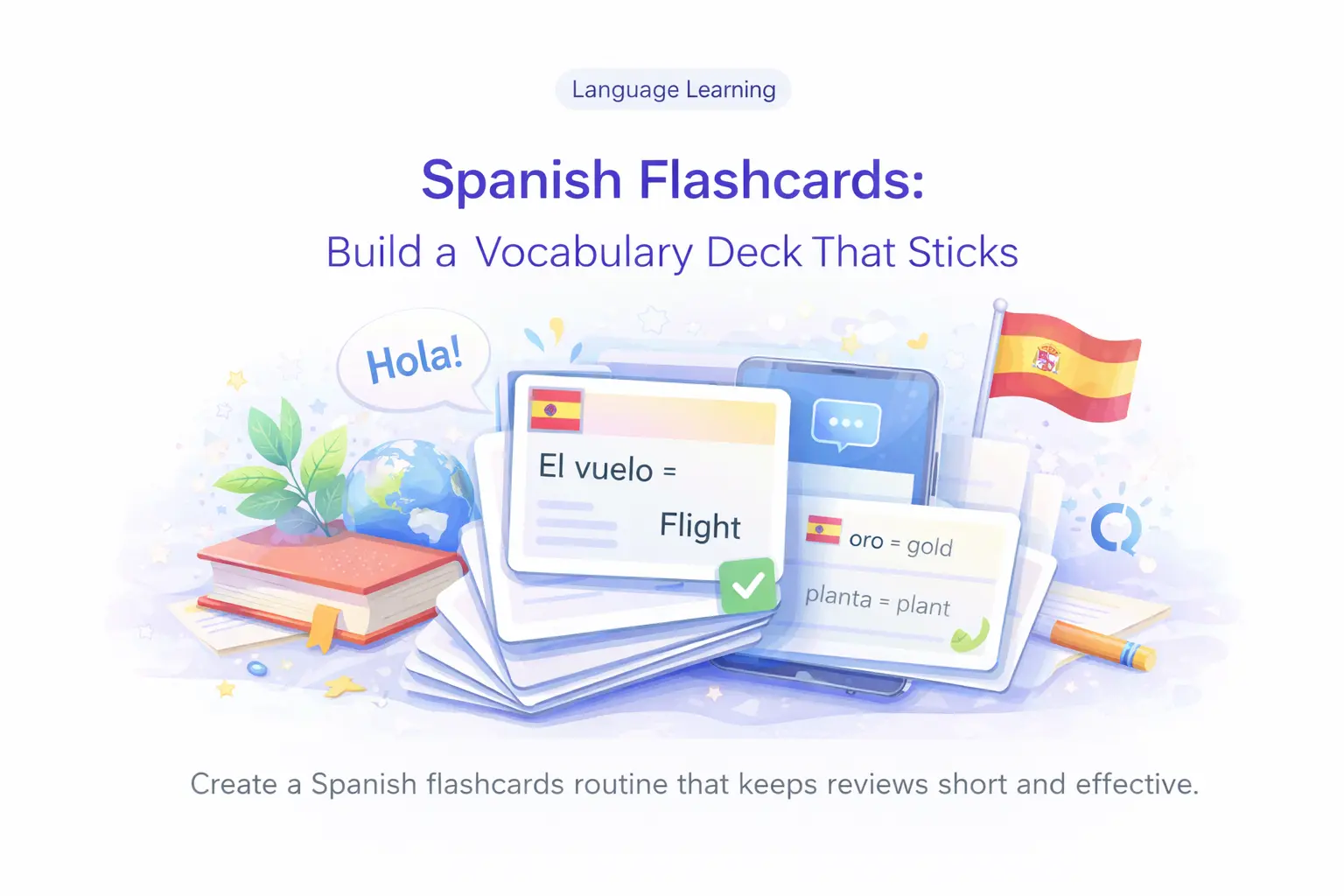
A good Spanish flashcards deck is short, focused, and reviewed on a steady schedule. Use your own class lists, keep answers brief, and review a little every day.
Key takeaways
- One word or phrase per card.
- Use short, speakable answers.
- Daily review beats weekend cramming.
Start with the right list
Use your class notes, textbook vocabulary, or lecture slides. If you are self-studying, pull from a single topic (travel, food, health) so the deck stays focused. Research on vocabulary acquisition shows that learning words in thematic clusters helps you form mental associations. When you learn "cocina" (kitchen), "cuchillo" (knife), and "plato" (plate) together, each word reinforces the others.
Avoid pulling vocabulary from random word-frequency lists unless you have a specific goal. The most useful words are the ones you will actually encounter in your class, your textbook, or the conversations you want to have. A deck of 30 words you need this week beats a deck of 500 words from a generic list.
Best topics to start with
If you are building your first Spanish deck from scratch, these topic groups give you the most practical coverage:
- Greetings and introductions: Hola, buenos dias, me llamo, mucho gusto, como estas. These are the first words you will use in any conversation and they build confidence fast.
- Numbers 1-100: Essential for prices, addresses, phone numbers, and time. Practice both reading the numeral and producing the Spanish word.
- Food and restaurants: La cuenta, el menu, agua, pollo, arroz, ensalada. Food vocabulary is immediately useful for travel and daily life.
- Travel and directions: Donde esta, a la derecha, a la izquierda, la estacion, el aeropuerto. These phrases make navigating a Spanish-speaking city much easier.
- Common verbs: Ser, estar, tener, ir, hacer, querer, poder. These high-frequency verbs appear in almost every sentence. Focus on present tense conjugations first.
Design short prompts
- Front: English term or short phrase. Keep it to one concept. "How do you say 'I want water'?" is better than "Translate the following sentence about wanting a beverage."
- Back: Spanish translation you can say aloud in one breath. For "I want water," the answer is "Quiero agua." Short, clear, speakable.
- Extras: Put examples in the explanation field, not the main answer. You might add a note like "querer is a stem-changing verb: quiero, quieres, quiere" but keep that separate from the primary answer.
Build a three-part deck
- Core vocab: The 20-40 words you will see on quizzes. These are the non-negotiable terms from your current chapter or unit. Every word on your class vocabulary list should have a card. Front: English word. Back: Spanish word with article if it is a noun (el libro, la mesa).
- Verbs: Focus on the tense your class is covering. If you are studying preterite, make cards for the most common irregular forms: fui, fue, hice, dijo, puso. Include the infinitive on the front so you learn to connect the conjugated form to the base verb.
- Useful phrases: Short, real-world phrases you want to recall fast. "Where is the bathroom?" (Donde esta el bano), "How much does it cost?" (Cuanto cuesta), "I do not understand" (No entiendo). These phrases build conversational fluency alongside vocabulary knowledge.
How to practice pronunciation with flashcards
Flashcards are visual by default, but you can turn them into pronunciation practice by adding one step: say every answer out loud before flipping the card. This engages your motor memory and trains your mouth to form Spanish sounds. Silent review builds recognition, but spoken review builds production, and production is what you need for conversation.
Pay special attention to sounds that do not exist in English. The rolled "rr" in "perro," the soft "j" in "rojo," and the distinction between "b" and "v" (which sound nearly identical in Spanish) all require practice. When you encounter a word with a tricky sound, repeat it three times before moving to the next card. Over a week of daily review, this adds up to hundreds of pronunciation repetitions without any extra study time.
A simple review schedule
Review new cards daily for the first week, then every 2-3 days. Keep sessions under 20 minutes and prioritize cards you miss. A good rhythm is 10 minutes in the morning with new and difficult cards, then a quick 5-minute review in the evening to reinforce what you learned that day.
After two weeks, most of your original cards should feel easy. At that point, add a new batch of 20-30 words from your next chapter and repeat the cycle. The old cards will still appear occasionally to prevent forgetting, but the bulk of your time shifts to new material.
Tracking your progress
Keep a simple count of how many cards you can answer correctly on the first try each session. When that number climbs above 80% for a deck, you are ready to add new material. If it drops below 60%, you are adding new cards too fast and need to spend more time on review.
Another useful metric is speed. At the beginning, you might take 5-10 seconds per card. As fluency builds, that drops to 2-3 seconds. When you can answer a card as fast as you can read it, that word is truly learned and you can trust spaced repetition to maintain it with minimal effort.
Common mistakes
- Too much on one card: Split double prompts into two cards. "How do you say hello and goodbye?" should be two separate cards.
- Skipping hard cards: Those are the ones that build fluency. The words you struggle with are exactly the words you need to practice most.
- Reviewing without speaking: Say the answer out loud for stronger recall. Silent study trains recognition. Spoken study trains production.
Wrap up
A consistent, short deck beats a giant list you never review. Start with one topic, keep your cards speakable, and review daily. If you want to build a focused deck quickly, try the Spanish flashcards app and start with your latest notes.
Frequently Asked Questions
How many Spanish vocabulary words should I learn per day?
Should I learn Spanish vocabulary in context or in isolation?
How do I practice Spanish pronunciation with flashcards?
Related articles
Continue learning with these related posts.
Put these techniques into practice
Upload your study materials and let Laxu AI create flashcards, notes, and quizzes automatically.