Spanish Quiz Generator: Build Practice Tests That Work
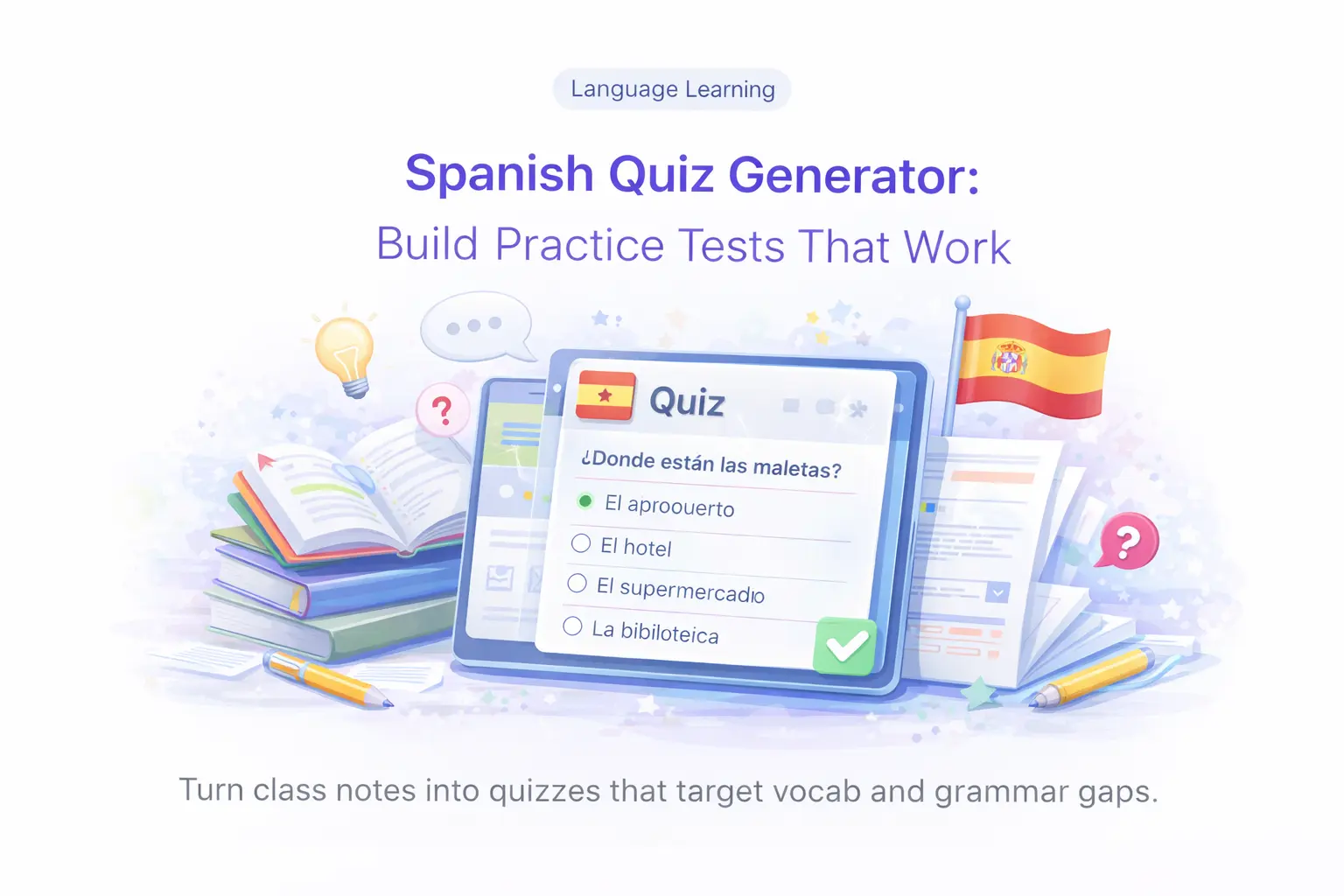
Spanish quizzes work best when they target one topic at a time and give you quick feedback. Use your notes to create short quizzes that focus on grammar, verbs, and vocab recall.
Key takeaways
- Keep each quiz focused on one unit or chapter.
- Mix question types to test both recall and application.
- Review missed items with a flashcards deck.
Why quizzes beat rereading
Rereading notes feels productive but does very little for long-term memory. You recognize the words on the page and mistake that familiarity for knowledge. Quizzes force you to produce an answer from memory, which is a fundamentally different cognitive process. Psychologists call this the testing effect: the act of being tested on material improves retention more than additional study time.
In a Washington University study, students who practised retrieval recalled about 50% more a week later than students who simply re-read the material: 61% of the passage versus 40% (Roediger & Karpicke, Psychological Science, 2006). The delay is the load-bearing part of that sentence - on an immediate test in the same study, the re-readers actually scored higher, and the retrieval advantage only appears once a week has passed. The key insight is that retrieval, not re-exposure, drives learning. Every time you answer a quiz question, you strengthen the neural pathway to that piece of knowledge. Getting the answer wrong is almost as valuable as getting it right, because the correction creates a strong memory trace.
Pick a tight topic
Choose one lesson or chapter. Mixing too much content makes it hard to see what you actually know. If your class just covered preterite tense irregular verbs, build a quiz on exactly that. You will get a clear signal about which verbs you know and which ones need more work.
Focused quizzes also reduce the mental load of switching between topics. When every question targets the same grammar rule or vocabulary theme, you build depth instead of skimming the surface of five different subjects.
Use a balanced format
- Multiple choice: Fast check on definitions and verb forms. Example: "What is the preterite form of 'ir' for 'yo'?" with options a) fui, b) fue, c) iba, d) voy. Multiple choice works best for testing recognition and eliminating common confusion pairs.
- True/false: Quick grammar checks. Example: "True or false: 'Estoy bien' uses the verb ser." These questions are fast to answer and good for testing rules and exceptions. Use them to target specific misconceptions your class has covered.
- Short answer: Stronger recall for key phrases. Example: "Translate: 'I went to the store yesterday.'" Short answer questions require production, not just recognition, making them the most demanding format. They are closest to what you need to do in actual conversation.
- Fill in the blank: Test conjugation and agreement in context. Example: "Ella ___ (ir) al mercado ayer." This format forces you to apply grammar rules within a sentence, which is harder than conjugating a verb in isolation.
A well-balanced quiz might include 3-4 multiple choice questions, 2 true/false, 3 short answer, and 2 fill-in-the-blank. This mix tests recognition, rule application, and production in a single session.
How many questions per quiz
For daily practice, 8-12 questions is the sweet spot. This takes about 5-10 minutes and gives you enough data to see patterns in your mistakes without causing fatigue. If you are reviewing before a major exam, a 20-25 question quiz works as a weekly check-in to simulate test conditions.
Avoid quizzes longer than 30 questions for regular practice. Long quizzes take too much time, which makes you less likely to do them consistently. Consistency matters more than quiz length. Five 10-question quizzes spread across a week teach you more than one 50-question quiz on Sunday night.
Make quizzes short and frequent
5-12 questions is enough for a daily review. Save longer quizzes for weekly check-ins. The goal is to make quizzing a habit, not an event. If you can finish a quiz in under 10 minutes, you are more likely to do it every day. Daily repetition with immediate feedback is what drives improvement.
Try to quiz yourself at the same time each day. Attach it to an existing habit: right after your morning coffee, during a study break, or before bed. The regularity matters more than the specific time.
Sample quiz workflow
- Monday: Upload your Chapter 5 notes to the Spanish quiz generator. Generate a 10-question quiz covering the new vocabulary and grammar.
- Tuesday: Take the quiz. Review your results and note which questions you missed.
- Wednesday: Generate a new quiz focused specifically on the areas you missed. If you struggled with preterite irregular verbs, ask for more questions on that topic.
- Thursday: Take a mixed quiz that combines this week's material with last week's. This tests whether older knowledge is holding up.
- Friday: Final quiz of the week. Use this as a benchmark. If you score above 80%, you are ready to move on. Below 80%, spend the weekend reviewing with flashcards.
Combining quizzes with flashcards
Quizzes and flashcards serve different purposes and work best together. Flashcards build the raw vocabulary and grammar knowledge you need. Quizzes test whether you can apply that knowledge under pressure, in context, and from memory. Think of flashcards as training and quizzes as scrimmages.
A practical system: study your Spanish flashcards for 10 minutes, then immediately take a short quiz on the same material. The flashcard session primes your memory, and the quiz tests whether that priming translates into actual recall. Any question you miss on the quiz becomes a new flashcard, closing the loop.
Turn mistakes into a study set
Every missed question becomes a flashcard. This keeps your review focused on the exact gaps in your knowledge. Do not just note that you got a question wrong. Analyze why you got it wrong. Did you confuse two similar verb forms? Did you forget a vocabulary word? Did you misapply a grammar rule? The specific error tells you what kind of card to create.
For example, if you answered "fue" when the correct answer was "fui," your card should focus on the yo vs. el/ella distinction for the preterite of "ir." A card that says "Preterite of ir, yo form: ___" with the answer "fui" directly targets the mistake. Over time, your error-based flashcard deck becomes a personalized study guide that focuses exclusively on your weak points.
Wrap up
Short quizzes, clear topics, and quick feedback are the fastest way to improve. The testing effect is one of the most well-supported findings in learning science, and applying it to Spanish study is straightforward. Build your first set with the Spanish quiz generator and pair it with Spanish flashcards for review.
Frequently Asked Questions
How many questions should a Spanish practice quiz have?
What types of questions work best for Spanish quizzes?
How do I use quiz mistakes to improve my Spanish?
Related articles
Continue learning with these related posts.
Put these techniques into practice
Upload your study materials and let Laxu AI create flashcards, notes, and quizzes automatically.