The Feynman Technique: 4 Simple Steps to Master Any Subject
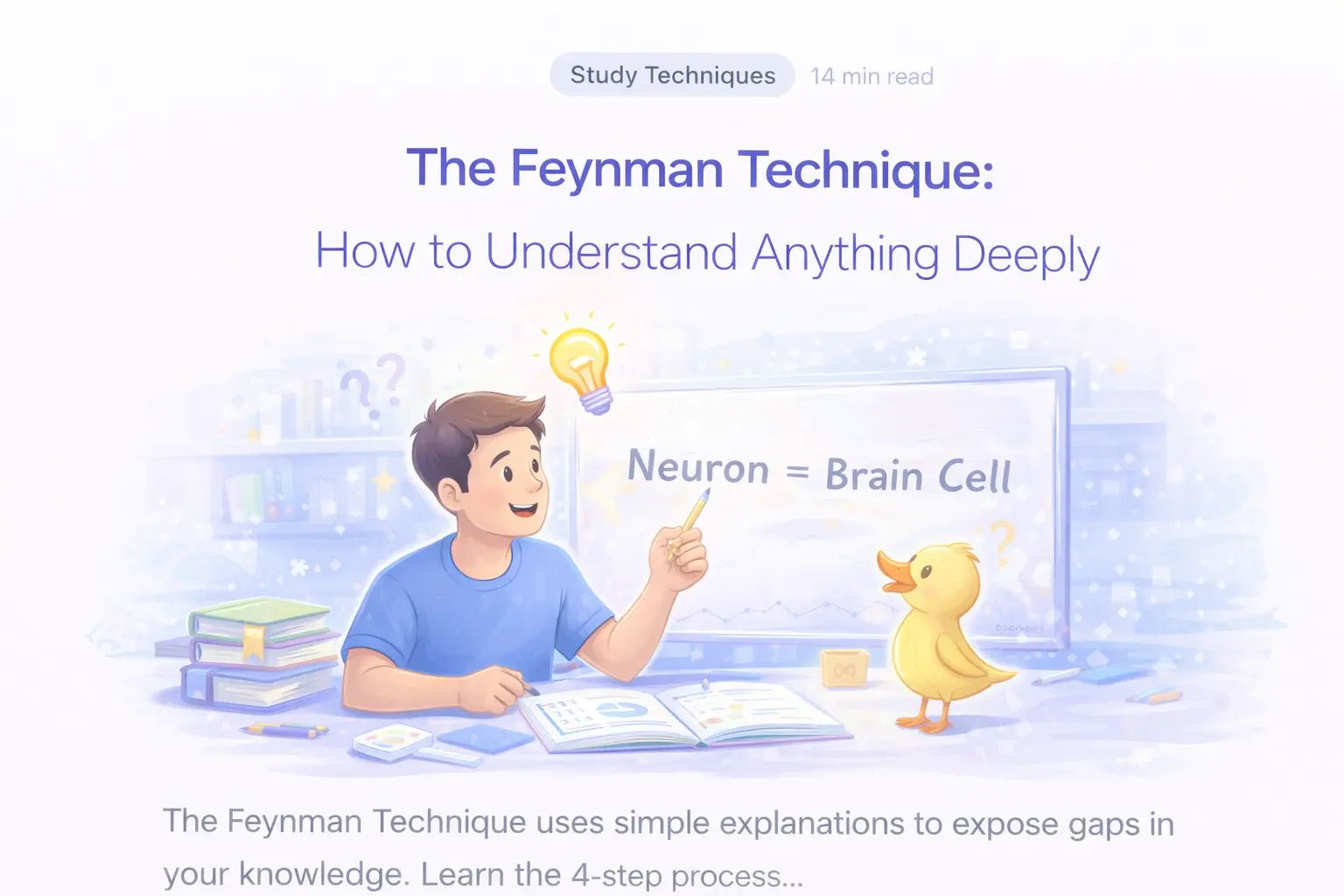
The Feynman Technique uses simple explanations to expose gaps in your knowledge. Named after Nobel Prize-winning physicist Richard Feynman, the core principle is direct: if you can't explain something in plain language, you don't truly understand it.
Most students confuse recognition with understanding. You read a textbook explanation, nod along, and think you've got it. Then on the exam, when you need to apply or explain the concept, everything goes blank. The Feynman Technique prevents this by forcing you to confront what you actually know versus what you only think you know.
This guide covers the four-step process, why it works according to cognitive science, and how to apply it to any subject you're studying.
Summary
- The Feynman Technique exposes the gap between recognizing information and truly understanding it—students who use explanation-based learning score up to 50% higher on application questions.
- The 4-step process: choose a concept, explain it simply, identify gaps, then simplify further. Each cycle deepens understanding.
- Teaching (even to an imaginary audience) activates deeper cognitive processing than passive review, improving retention by 20-30% in research studies.
- The technique works for any subject but is especially powerful for complex, interconnected topics where memorization fails.
Who was Richard Feynman and why does his method work?
Richard Feynman (1918-1988) won the Nobel Prize in Physics for his work on quantum electrodynamics. But he's equally famous for his teaching ability—he could explain quantum mechanics to undergraduates in ways that made complex ideas feel intuitive.
Feynman despised what he called "fragile knowledge"—the kind where you can recite a definition but can't actually use the concept. He noticed that many students and even professors hid behind jargon, using complicated words as a substitute for real understanding.
His insight: the ability to explain something simply is proof that you understand it. If you can't explain a concept without jargon, you're not demonstrating understanding—you're demonstrating memorization.
What are the four steps of the Feynman Technique?
Step 1: Choose a specific concept
Select one concept you want to understand better. Be specific—"photosynthesis" is better than "biology," and "the light-dependent reactions of photosynthesis" is better still.
Write the concept name at the top of a blank page. This physical act signals to your brain that you're about to actively engage, not passively consume.
Step 2: Explain it as if teaching a 12-year-old
Write an explanation of the concept using only simple language. Imagine you're teaching it to a smart 12-year-old who has no background in the subject. Rules:
- No jargon: If you use a technical term, define it in simple words
- Short sentences: If a sentence requires multiple commas or "which" clauses, break it up
- Concrete examples: Connect abstract ideas to everyday experiences
- Analogies: Compare new concepts to things your audience already understands
The key is to actually write or speak the explanation, not just think it. The act of articulating exposes gaps that mental rehearsal hides.
Step 3: Identify gaps and return to source material
As you explain, you'll hit points where you get stuck, use vague language ("it kind of works by..."), or unconsciously slip back into jargon. These are your knowledge gaps.
- Mark every point where your explanation falters
- Return to your source material (textbook, notes, lectures) specifically looking to fill those gaps
- Don't just re-read—actively search for the missing piece
- Return to Step 2 and try explaining again
This cycle—explain, identify gaps, research, explain again—is where the real learning happens. Each iteration deepens your understanding.
Step 4: Simplify and refine with analogies
Once you can explain the concept without gaps, make your explanation even better:
- Cut remaining complexity—if something can be said simpler, say it simpler
- Find better analogies that capture the essential mechanism
- Create a narrative flow that builds understanding step by step
- Test your explanation on someone else if possible
The goal isn't to dumb down the concept—it's to find the clearest, most direct path to genuine understanding.
Why does the Feynman Technique work according to cognitive science?
It exposes the illusion of knowledge
Psychological research shows that humans consistently overestimate their understanding of how things work—a phenomenon called the "illusion of explanatory depth." We think we understand zippers, toilets, and economics until someone asks us to explain them step by step.
The Feynman Technique forces confrontation with this illusion. You discover what you actually know versus what you assumed you knew.
It activates deeper cognitive processing
Research on the "generation effect" and "teaching expectancy" shows that preparing to teach material produces better learning than preparing to be tested on it. When you expect to explain something, you automatically process it more deeply, looking for connections and implications rather than just memorizing facts.
It creates multiple retrieval pathways
When you explain a concept using analogies and simple language, you create multiple mental connections to that knowledge. Instead of one pathway to the information (the original technical framing), you now have several—making the knowledge more accessible in different contexts.
It provides immediate feedback
You instantly know when you're stuck or using vague language. This immediate feedback beats waiting until an exam to discover you didn't understand something.
What does the Feynman Technique look like in practice?
Example 1: Explaining inflation
Jargon explanation: "Inflation is the rate at which the general level of prices for goods and services rises, eroding purchasing power."
Feynman explanation: "Imagine there's a small island with 100 people and 100 dollars in circulation. Each person can buy roughly one dollar's worth of stuff. Now the island's government prints another 100 dollars. There are still the same number of goods, but twice as much money chasing them. Sellers realize people have more money to spend, so they raise prices. Now each dollar buys half as much as before. That's inflation—more money chasing the same goods means each dollar is worth less."
Example 2: Explaining DNA replication
Jargon explanation: "DNA replication is a semiconservative process initiated at origins of replication where helicase unwinds the double helix and DNA polymerase synthesizes new strands."
Feynman explanation: "Imagine DNA as a twisted zipper. When a cell needs to divide, it needs two copies of its DNA. An enzyme comes along and unzips the zipper down the middle—separating the two halves. Then, other enzymes read each half and build a matching partner for it. Since each new zipper has one old half and one new half, each copy is half old, half new. That's why it's called semiconservative—each copy conserves half of the original."
What mistakes sabotage the Feynman Technique?
- Thinking instead of writing: Mental explanations let you skip over gaps. Writing forces completeness.
- Defining jargon with jargon: If you explain "supply" using "demand curves," you haven't simplified—you've just moved the problem.
- Stopping at recognition: Being able to repeat an explanation isn't understanding. Can you answer follow-up questions? Can you apply it to new situations?
- Glossing over gaps: When you hit a spot you can't explain, the temptation is to wave your hands and move on. That's exactly where you need to stop and dig deeper.
- Making it too long: The goal is clarity, not comprehensiveness. A shorter, clearer explanation usually indicates better understanding.
How does the Feynman Technique combine with other study methods?
The Feynman Technique integrates naturally with other evidence-based learning strategies:
- Active recall: Before writing your explanation, try to recall what you know without looking at sources. Then check and fill gaps. This combines retrieval practice with explanation. Learn more in our active recall guide.
- Spaced repetition: Revisit your explanations over days and weeks. Can you still explain it simply? Use spaced repetition to schedule reviews.
- Flashcards: Turn your simplified explanations into flashcards for long-term retention.
- Study groups: Actually teach your explanations to classmates. Their questions reveal remaining gaps.
When should you use the Feynman Technique?
The technique is especially valuable for:
- Complex concepts with multiple interconnected parts (economics, biology, physics)
- Topics where you've been memorizing but not truly understanding
- Preparing to teach or present material to others
- Exam prep when you need to apply concepts, not just recognize them
- Learning subjects outside your expertise
- Debugging confusion—when something "should" make sense but doesn't
Wrap up
The Feynman Technique is more than a study hack—it's a mindset shift about what it means to truly understand something. By forcing yourself to explain concepts in simple terms, you'll discover gaps in your knowledge, build deeper understanding, and remember material longer. As Feynman himself said: "The first principle is that you must not fool yourself—and you are the easiest person to fool."
Frequently Asked Questions
What are the four steps of the Feynman Technique?
How does the Feynman Technique improve exam performance?
When should I use the Feynman Technique instead of flashcards?
Related articles
Continue learning with these related posts.

Put these techniques into practice
Upload your study materials and let Laxu AI create flashcards, notes, and quizzes automatically.