Active Recall vs Passive Recall: Which Works Better?
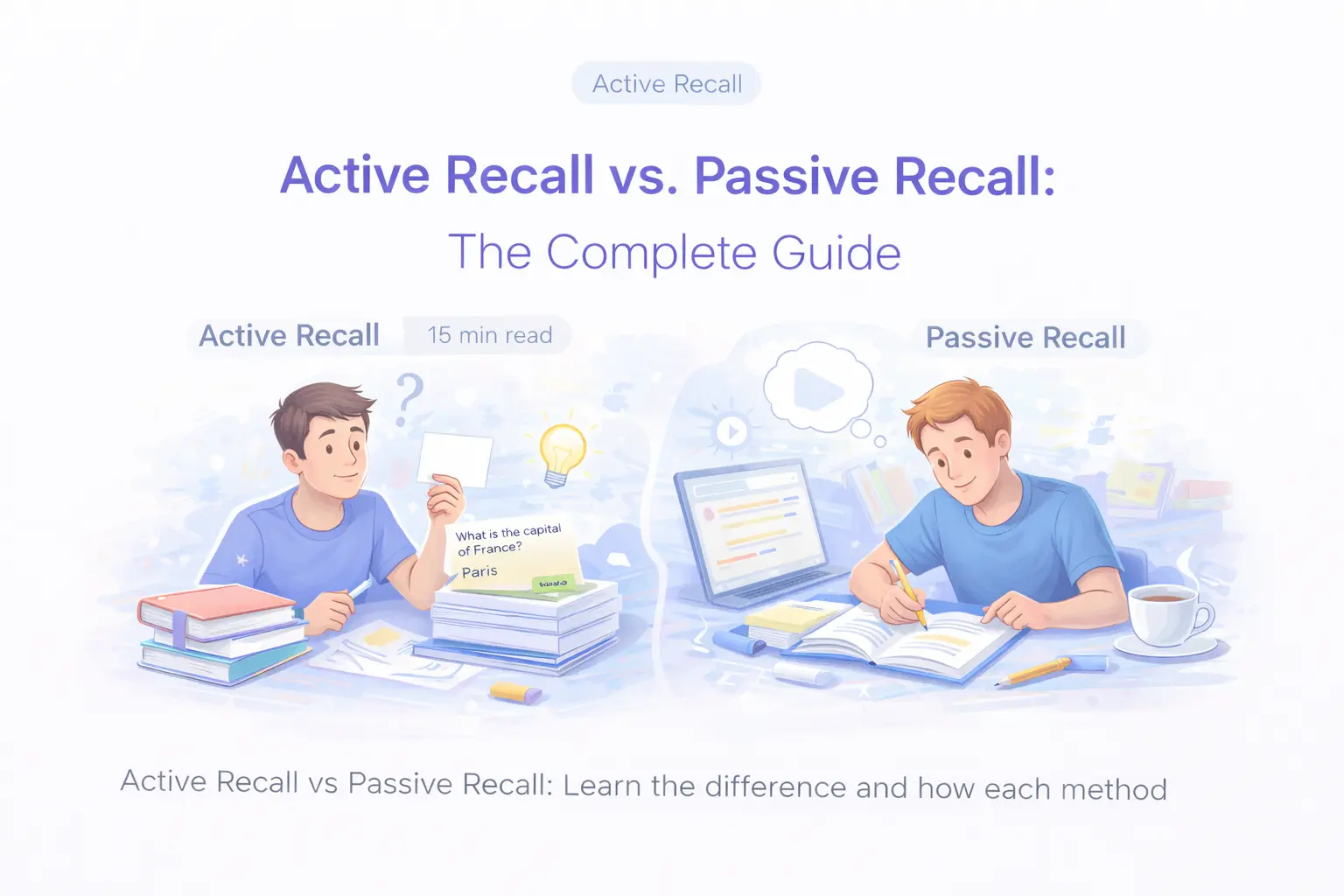
Active Recall vs Passive Recall: Learn the difference and how each method impacts studying, retention, and long-term memory.
You read your notes three times, highlight half the page, then blank out on test day—sound familiar? Active Recall vs Passive Recall matters because methods like retrieval practice push self-testing over passive rereading, turning fragile short-term memory into dependable long-term retention.
This article breaks down the testing effect, spaced repetition, practice testing, and metacognitive checks so you can retain information 2-3x faster, ace exams or learn new skills with less effort, and stop wasting time on endless rereading. To make that shift practical, Laxu AI offers an AI study tool that guides your sessions, schedules smart reviews, and gives quick feedback so you remember more with less wasted time.
Summary
- Active recall forces production, not recognition, and 80% of students who use active recall report improved retention, showing retrieval practice converts fragile familiarity into durable memory pathways.
- Active recall delivers measurable performance gains, with students using it scoring about 20% higher on average in exams. Targeted retrieval shortens total study time; active recall can reduce it by around 30% while maintaining learning outcomes.
- Passive review has a steep cost, with passive methods yielding retention near 20% and students using them spending up to 50% more time studying than peers who use retrieval practice.
What is Active Recall?
Active recall accelerates learning by forcing you to retrieve information, not just recognize it, and that retrieval builds durable memory pathways that show up as better exam performance and less wasted study time.
Think of it as doing reps for memory, not watching a highlight reel; the effortful pull of an answer actually consolidates it. According to research from Immerse Education, 80% of students who use active recall report improved retention, and learners consistently experience this difference in day-to-day recall.
How exactly does retrieval reshape memory?
The same neural pattern shows up across studies: trying to pull an answer from an empty head strengthens the pathway more than rereading the answer on the page. That practice of reconstruction, followed by corrective feedback, converts fragile familiarity into ready recall.
Think of it as doing reps for memory, not watching a highlight reel; the effortful pull of an answer actually consolidates it. The struggle you feel when trying to remember something isn't wasted effort—it's the exact mechanism that makes the memory stick.
Why does active recall save time and cut procrastination?
This pattern appears repeatedly in classroom and exam prep settings: students spend hours polishing notes and planning study sessions because that feels productive, but recognition-based review rarely translates into reliable answers under pressure. That gap creates anxiety and wasted hours.
When you switch to short, focused retrieval cycles, you force gap detection early, then use targeted review only where it matters, so total study time falls while mastery climbs. It is energizing to see weak points quickly, and the relief students describe when they replace planning with doing is real and sustained.
Research published in Psychological Science in the Public Interest found that students using active recall can reduce total study time by 30% while maintaining or improving learning outcomes.
Most students keep rereading because it is familiar, but what's the hidden cost and the better route?
Most students manage exam prep by re-reading notes because it is comfortable and requires no new tools. That habit scales badly: as material accumulates, passive reading balloons into dozens of unfocused hours and leaves recall fragile under test conditions.
The fix is straightforward. After every lecture or reading block, close the source and write or say everything you remember. Then check. Repeat until the gaps shrink. That simple loop replaces highlight-heavy marathons with short bursts that actually build lasting recall.
What is Passive Recall?
Passive recall relies on recognition cues—rereading notes, scanning highlighted passages, or watching a lecture again—without forcing the brain to produce the answer independently. The information feels familiar, but familiarity is not the same as recall.
Most students default to passive methods because they feel comfortable and require no extra planning. The catch is that recognition barely scratches the surface of memory; under test conditions, where no cues exist, those fragile traces often fail.
How do passive methods create the illusion of learning?
When you reread a sentence and it "makes sense," your brain registers ease, and ease feels like mastery. But that feeling is fluency, not retrieval strength. Fluency fades fast once the book closes, leaving students surprised when they blank on the exam.
Highlighting, summarizing, and copying notes trigger the same trap: the motor activity or the neat formatting tricks you into believing the material is locked in. It rarely is. Only when you pull an answer with no cues present do you truly measure what sticks.
What does the research say about passive review?
Studies consistently show that passive review yields retention rates near 20% after a week, compared to 60-80% for active retrieval methods. Students relying solely on passive methods often spend 50% more time studying to achieve similar outcomes as those using active recall.
A landmark 2011 study by Karpicke and Blunt compared four study methods: reading once, reading four times, creating concept maps, and retrieval practice. The retrieval group significantly outperformed all others on both verbatim and inference tests, even though they spent less total time with the material.
Active Recall vs Passive Recall: A Direct Comparison
The core difference: active recall forces your brain to produce information from scratch, while passive recall only asks it to recognize information when presented.
- Active recall: "What are the three branches of the U.S. government?" (You must retrieve the answer)
- Passive recall: Reading "The three branches are legislative, executive, and judicial" and thinking "yes, I knew that"
This difference explains why multiple-choice tests feel easier than short-answer tests, and why you might recognize a face but can't remember the name. Recognition is a weaker form of memory than production.
What usually breaks active recall, and how do you fix it?
The common failure modes are shallow prompts, cue dependence, and card overload. Shallow prompts ask for definitions only; deep prompts force application, explanation, or transfer. Cue dependence occurs when you practice only with the exact wording; vary phrasing and context. Card overload results from creating too many small items; prioritize high-value concepts and consolidate related facts into single contextual prompts.
If time is the constraint, use spaced short sessions focused on solving one problem type until it comes out cleanly, then move on.
How do you actually implement active recall?
1. Flashcards with retrieval focus
Create cards where the question forces genuine recall, not recognition. Instead of "What is mitochondria?" try "A cell needs energy for protein synthesis. Which organelle provides ATP and how?" The key is to genuinely attempt an answer before checking—that attempt is where learning happens.
2. The blank page method
After reading a chapter, close everything and write down everything you can remember. Don't organize as you go; just dump everything. Then open the source and see what you missed. Those gaps become your next study targets.
3. Practice testing under exam conditions
Find or create practice questions and take them timed, without notes. The closer your practice matches the actual test, the better prepared you'll be. Even if you only get 40% right initially, that struggle builds stronger memory than rereading would.
4. Teach it to someone (or pretend to)
Explaining a concept out loud forces you to retrieve and organize information. If you stumble or use vague language, you've found a gap. This connects to the Feynman Technique—if you can't explain it simply, you don't understand it well enough.
How do you combine active recall with spaced repetition?
Active recall tells you how to study (test yourself). Spaced repetition tells you when to study (just before you forget). Combined, they form the most evidence-backed study system available.
The schedule: review new material after 1 day, then 3 days, then 1 week, then 2 weeks, then monthly. Each successful recall extends the next interval. Each failure resets it. This timing maximizes the strengthening effect while minimizing total review time.
Getting started this week
- Day 1: After your next lecture, spend 10 minutes writing everything you remember without looking at notes.
- Day 2: Turn the gaps you found into flashcards or practice questions.
- Days 3-7: Test yourself daily on those cards, tracking which ones you miss.
- Week 2: Add new material while reviewing old cards on a 2-3 day schedule.
That's it. No complex system required. The consistency of short retrieval sessions beats marathon rereading every time.
Wrap up
Active recall isn't just another study tip—it's the foundation of effective learning backed by over a century of research. By shifting from passive review to active testing, you'll remember more, study more efficiently, and perform better on exams.
The choice is straightforward: spend more time rereading and hoping, or spend less time testing yourself and knowing. Start with a blank page after your next class. Write what you remember. Check what you missed. Repeat. That loop, sustained, changes everything.
Frequently Asked Questions
What is active recall?
Is active recall better than rereading notes?
How do I start using active recall?
Can I combine active recall with spaced repetition?
Related articles
Continue learning with these related posts.
Put these techniques into practice
Upload your study materials and let Laxu AI create flashcards, notes, and quizzes automatically.