Spaced Repetition: How to Remember Anything Long-Term
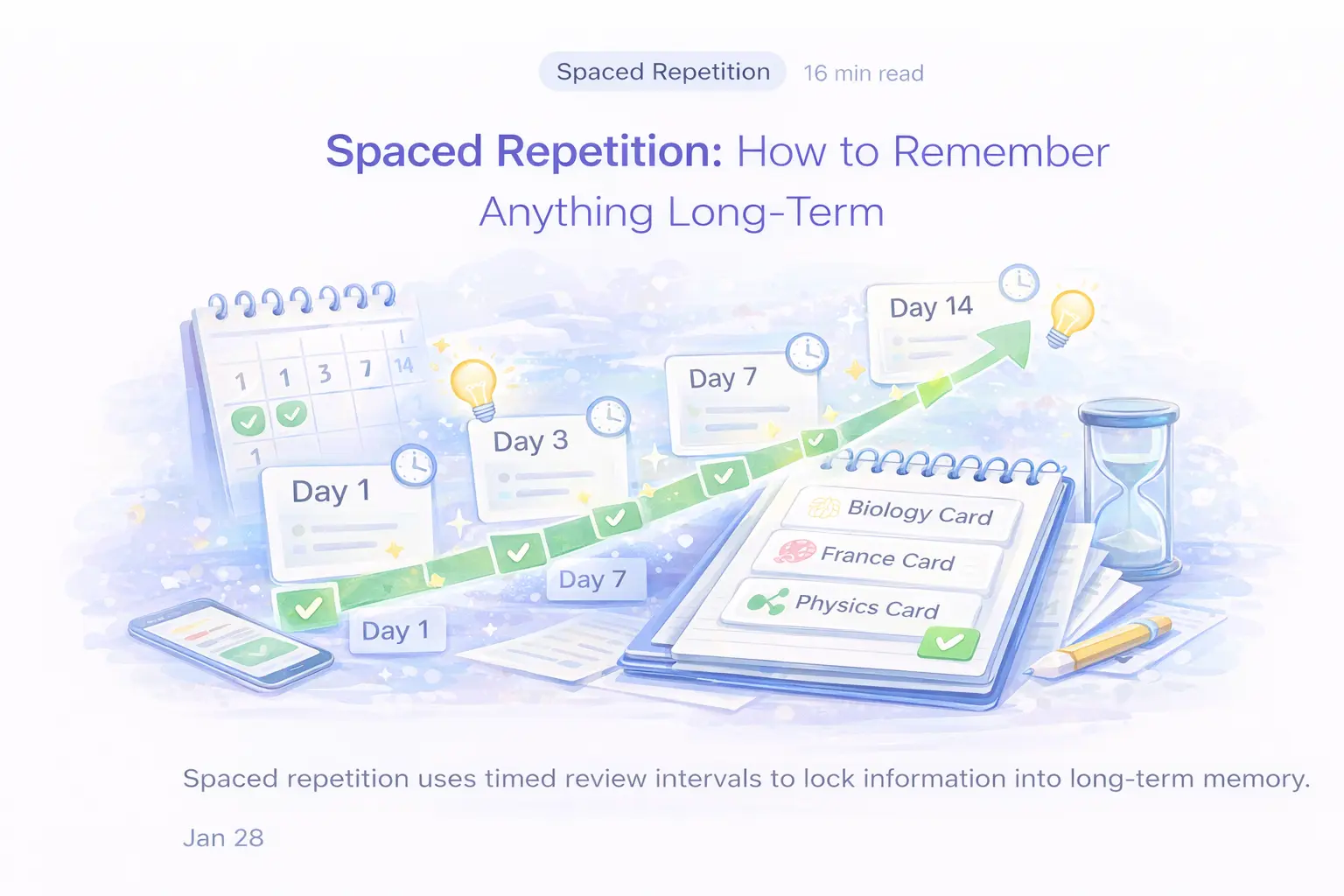
Spaced repetition uses timed review intervals to lock information into long-term memory. Instead of cramming before a test and forgetting everything after, you review material at strategic intervals so it stays with you for months or years.
Most students discover too late that marathon study sessions produce fragile memories. You cram, pass the test, then lose 90% of the material within weeks. Spaced repetition solves this by working with your brain's natural forgetting patterns instead of against them.
This guide covers the science behind spacing, practical schedules you can use immediately, and common mistakes that sabotage results. By the end, you'll have a system that makes long-term retention automatic rather than accidental.
What the research says
Dunlosky et al. (2013) evaluated 10 popular study techniques in a landmark meta-analysis published in Psychological Science in the Public Interest. Only two techniques received the highest rating of "high utility": practice testing and distributed practice (spaced repetition). Highlighting, rereading, and summarizing were all rated "low utility." If you only change one thing about how you study, make it this.
Summary
- Without review, you forget 70% of new information within 24 hours and up to 90% within a week—the forgetting curve discovered by Ebbinghaus in 1885 still holds.
- Spaced repetition can improve long-term retention by 200% or more compared to massed practice (cramming), with some studies showing retention rates of 90%+ after months.
- The optimal review schedule starts at 1 day, then expands to 3 days, 1 week, 2 weeks, and 1 month—each successful recall roughly doubles the next interval.
- Consistency beats volume: 15-20 minutes daily produces better results than occasional 2-hour sessions.
What is the forgetting curve and why does it matter?
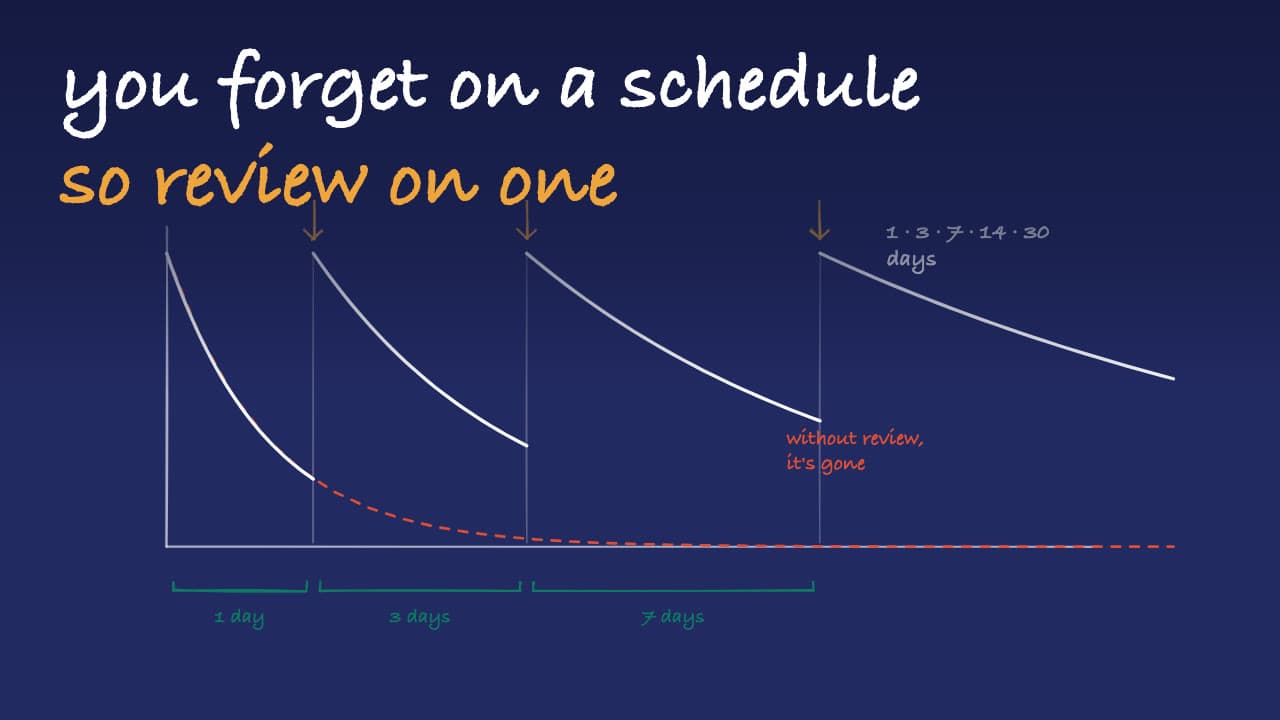
In 1885, German psychologist Hermann Ebbinghaus ran experiments on himself, memorizing lists of nonsense syllables and measuring how much he retained over time. His findings shocked the academic world: without active reinforcement, humans forget 70% of new information within 24 hours.
This isn't a flaw—it's a feature. Your brain constantly filters information, discarding what seems unimportant to make room for what matters. The problem is that your brain can't tell the difference between exam material you need and random facts you don't.
The good news: each time you successfully recall information, the forgetting curve flattens. The memory becomes more resistant to decay. After 4-5 well-timed reviews, information can stay accessible for months or years with only occasional refreshers.
How does spaced repetition actually work?
The core principle is counterintuitive: review material just as you're about to forget it. Not before (too easy), not after (already gone), but right at the edge of forgetting.
This timing creates what Bjork and Bjork (1992) call "desirable difficulty." The slight struggle to retrieve information strengthens the memory trace far more than easy recall would. It's like building muscle—you need resistance to grow stronger. This principle is also the foundation of active recall, one of the most powerful study techniques you can combine with spacing.
A typical spaced repetition schedule looks like this:
- Initial learning: Day 0
- First review: Day 1 (24 hours later)
- Second review: Day 4 (3 days later)
- Third review: Day 11 (1 week later)
- Fourth review: Day 25 (2 weeks later)
- Fifth review: Day 55 (1 month later)
- Subsequent reviews: Every 2-3 months
Each successful recall roughly doubles the next interval. Each failure resets the card to shorter intervals. Over time, well-known material fades into the background while difficult items get more attention.
Why does cramming fail for long-term retention?
Cramming works for short-term performance. You can absolutely pass tomorrow's test by studying all night. But here's what the research shows: Cepeda et al. (2006) analyzed 184 studies and found that distributed practice produces a 10-30% improvement in retention over massed practice. Within 2 weeks, students who crammed retain less than 20% of the material, while students who used spaced practice retain 60-80%.
The reason is biological. Memory consolidation—the process of transferring information from short-term to long-term storage—requires sleep and time. Walker (2017) showed that even one night of less than 6 hours of sleep reduces memory consolidation by up to 40%. Cramming bypasses this process entirely. You're essentially renting the information rather than owning it.
For subjects that build on themselves (languages, math, sciences), this creates a compounding problem. Each new topic assumes you remember the previous ones. If you don't, you're constantly re-learning basics instead of progressing.
What does the research say about spaced repetition effectiveness?
The evidence for spaced repetition is overwhelming. Cepeda et al. (2006) conducted a meta-analysis in Psychological Bulletin that found spacing effects appear across nearly all types of learning material, all types of learners, and all retention intervals tested. Roediger and Karpicke (2006) demonstrated that students who tested themselves with spaced practice remembered 80% of material after one week, versus just 36% for students who only reread.
Specific findings include:
- Medical students using spaced repetition scored 20-50% higher on exams than peers using traditional methods (Kerfoot et al., 2010)
- Language learners retained vocabulary 2-3x longer with spaced practice compared to massed practice
- Karpicke and Roediger (2008) found that information reviewed with proper spacing was retained at 90% after 2 months, compared to 30% for non-spaced review
The technique is used extensively in medical education, flight training, and military applications where long-term retention literally saves lives.
Spaced repetition vs other study techniques
How does spaced repetition compare to other popular study methods? Here's what the research from Dunlosky et al. (2013) shows:
| Study Technique | Effectiveness | Best For | Time Investment |
|---|---|---|---|
| Spaced repetition | Very high | Long-term retention of facts, vocabulary, formulas | 15-20 min/day |
| Active recall | Very high | Deep understanding, exam preparation | 20-40 min/session |
| Interleaving | High | Problem-solving, distinguishing similar concepts | Variable |
| Feynman Technique | High | Complex concepts, deep comprehension | 20-40 min/concept |
| Pomodoro Technique | Moderate (focus aid) | Sustained concentration, avoiding burnout | 25 min + 5 break |
| Rereading notes | Low | Familiarity (not retention) | Variable |
| Highlighting | Low | Selecting key passages (not learning them) | Variable |
The winning combination
Spaced repetition works best when combined with active recall. Create flashcards from your textbooks, then review them on a spaced schedule. Each review session is an active recall exercise, and the spacing ensures long-term retention. This one-two punch is why flashcard apps with built-in spaced repetition algorithms are so effective. See our comparison of the best flashcard apps for recommendations.
How do you implement spaced repetition in practice?
Option 1: The Leitner Box System (physical cards)
This classic method uses boxes to track review intervals:
- All new cards start in Box 1 (review daily)
- Correct answers move to the next box (longer intervals)
- Wrong answers return to Box 1
- Box 2: every 2 days, Box 3: every 4 days, Box 4: weekly, Box 5: monthly
Advantages: No technology required, physical handling aids memory. Disadvantages: Harder to scale, no automatic scheduling.
Option 2: Digital flashcard apps
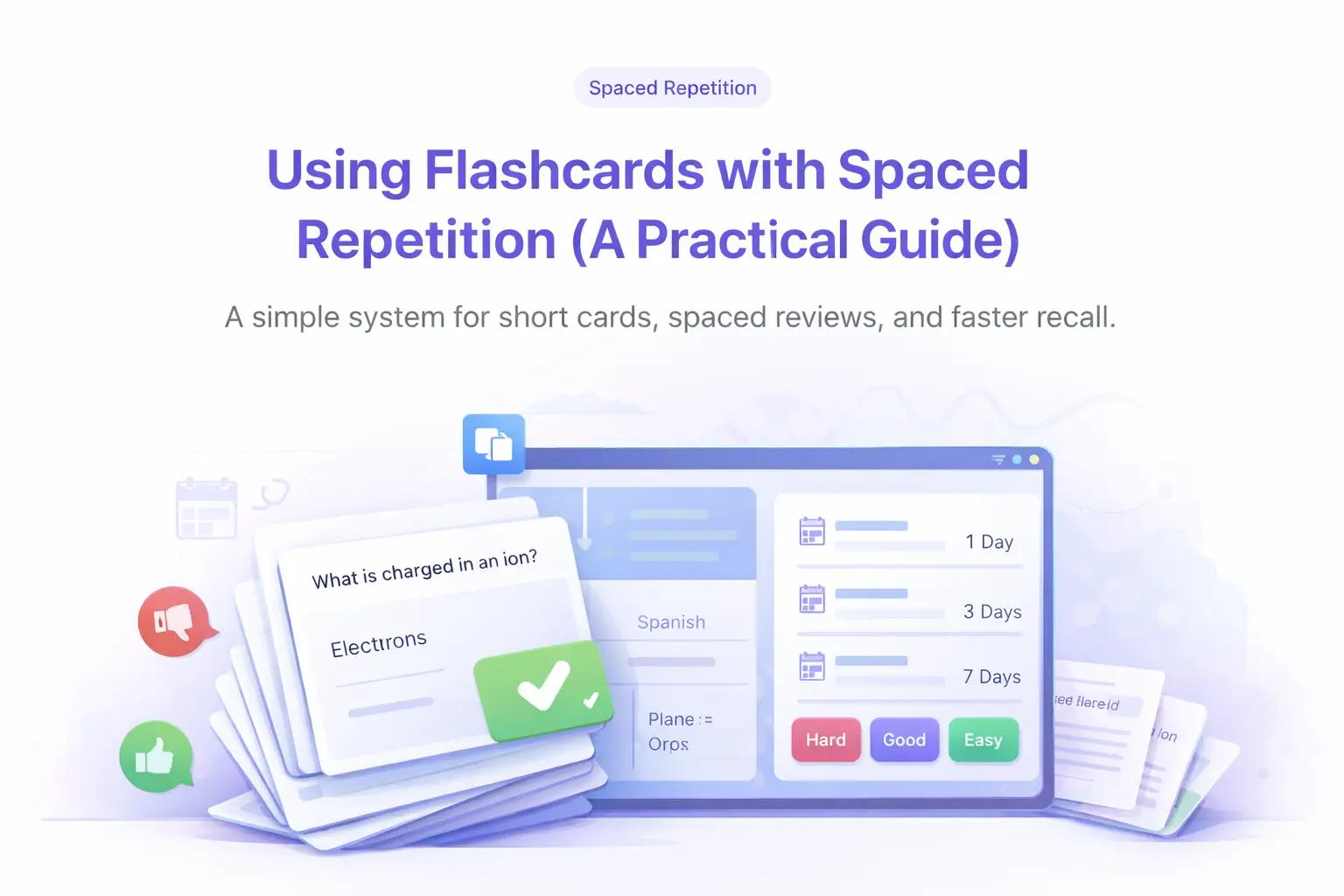
Apps like Laxu AI, Anki, or Quizlet use algorithms to schedule reviews automatically based on your performance. You create cards, review what the app shows you each day, and rate how well you remembered. With Laxu AI, you can also upload PDFs or photos of your notes and have the AI generate flashcards automatically—saving hours of manual card creation.
Advantages: Automatic scheduling, scales to thousands of cards, tracks statistics. For a detailed comparison, see our Laxu AI vs Quizlet vs Anki comparison.
Option 3: Calendar-based scheduling
For simpler needs, manually schedule reviews on your calendar:
- After learning something new, mark review dates: +1 day, +4 days, +11 days, +25 days
- Adjust intervals based on how easily you recall—longer if easy, shorter if hard
- Keep a simple log of what you reviewed and how it went
What makes a flashcard effective for spaced repetition?
The system only works if your cards are good. Poor cards produce wasted reviews and frustration. For a deeper dive, see our guide to making flashcards from textbooks. Follow these principles:
- One concept per card: "What are the three branches of government?" is three cards, not one. Bundling creates partial recall and fuzzy understanding.
- Use your own words: Copying directly from the textbook doesn't force processing. Paraphrasing proves you understand.
- Make questions specific: "What is X?" beats "Describe X." Vague prompts allow vague answers.
- Keep answers short: If you can't say the answer in one breath, the card is too complex. Split it.
- Add context when helpful: Example sentences, mnemonics, or images can strengthen connections without bloating the card.
What are the most common mistakes that sabotage spaced repetition?
- Adding too many cards at once: Reviews accumulate. Adding 50 new cards means 50+ reviews tomorrow, 100+ the next day. Start with 10-20 maximum per day.
- Skipping review sessions: Missing one day doesn't just delay cards—it breaks the spacing algorithm and creates backlogs. Consistency trumps intensity.
- Marking cards "correct" when you're unsure: Partial recall doesn't count. If you hesitated or guessed, mark it wrong. Better to see a card again than to think you know something you don't.
- Cards that are too easy or too hard: If you're getting 95%+ right, add harder material or increase intervals. If you're below 70%, break cards into smaller pieces or add more context.
- Quitting during the backlog phase: After initial enthusiasm, reviews pile up. This is normal. Push through the first month and reviews stabilize.
How do you apply spaced repetition to different subjects?
Languages
Vocabulary is the classic use case. Include: the word, pronunciation, gender (if applicable), an example sentence, and the translation. For grammar, create cards that force you to produce correct forms, not just recognize them.
Sciences
Break concepts into atomic facts: definitions, formulas, processes. But don't stop there—add cards that require application. "What is Newton's second law?" is less useful than "A 5kg object accelerates at 2 m/s². What force is applied?"
History
Dates and events are obvious candidates. But also create cards for causes, effects, and connections between events. History is about patterns, not just facts.
Medicine and Law
These fields require massive amounts of retention. Use hierarchical tagging to organize cards by topic. Focus on high-yield material first. For medicine specifically, see our MCAT study guide. For law, check out law school study tips. Combine with active recall techniques and AI-generated practice quizzes for maximum effect.
How do you build a sustainable daily habit?
The best system fails if you don't use it. Here's how to make spaced repetition stick:
- Anchor it to an existing habit: Review cards right after morning coffee, during your commute, or before bed. Linking to established routines increases adherence.
- Start embarrassingly small: 5 cards per day for the first week. Success breeds consistency. You can always add more later.
- Track your streak: Most apps show consecutive days reviewed. Protecting that streak becomes surprisingly motivating.
- Plan for bad days: On busy or exhausting days, do the minimum—even 2 minutes counts. Breaking the chain hurts more than a light session helps.
- Review your stats weekly: Look at retention rates, cards learned, time spent. Seeing progress sustains motivation when the novelty fades.
Wrap up
Spaced repetition isn't magic—it's applied cognitive science. Your brain forgets on a predictable schedule, and spaced repetition exploits that schedule to make retention automatic rather than accidental. Ebbinghaus discovered the forgetting curve in 1885, Bjork and Bjork (1992) explained why spacing works through desirable difficulties, and Dunlosky et al. (2013) confirmed it as one of only two "high utility" study techniques. The science is settled.
The investment is small: 15-20 minutes daily. The payoff is substantial: information that stays with you for years, not just until the test. Medical students, polyglots, and high-performers across fields use this technique because it works.
Start today. Upload a PDF to Laxu AI, generate flashcards in seconds, and review them tomorrow with built-in spaced repetition. Then the day after. Then in 3 days. Within a month, you'll understand why this technique has survived 130+ years of scientific scrutiny—because nothing else comes close for building durable long-term memory.
For more science-backed study strategies, explore our guides on 5 study techniques that actually work, how to memorize faster, and the science of memory.
Frequently Asked Questions
What is the forgetting curve and how does spaced repetition fight it?
What is the best spaced repetition schedule for beginners?
How much time should I spend on spaced repetition daily?
Related articles
Continue learning with these related posts.
Put these techniques into practice
Upload your study materials and let Laxu AI create flashcards, notes, and quizzes automatically.