The Pomodoro Technique: A Complete Guide to Focused Study Sessions
The Pomodoro Technique uses timed work intervals and strategic breaks to combat procrastination, reduce mental fatigue, and maintain focus during study sessions. It's one of the most widely adopted productivity methods because it works with your brain's natural attention patterns rather than against them.
You sit down to study with good intentions, then three hours later realize you've accomplished almost nothing. Sound familiar? The problem isn't laziness—it's that sustained focus is cognitively expensive, and your brain will find ways to avoid it. The Pomodoro Technique solves this by breaking work into manageable chunks with built-in recovery periods.
This guide covers the original method, the science behind why it works, practical variations for different study scenarios, and how to combine it with other evidence-based learning techniques for maximum effectiveness.
Summary
- The Pomodoro Technique structures work into 25-minute focused intervals separated by 5-minute breaks, with longer 15-30 minute breaks every 4 cycles.
- Research shows that attention and focus decline significantly after 20-25 minutes of sustained concentration, making timed intervals neurologically sound.
- Users report 40% less procrastination when using the technique, largely because committing to "just 25 minutes" feels manageable.
- The technique provides built-in feedback: tracking pomodoros reveals that most people overestimate what they can accomplish and underestimate how long tasks take by 50% or more.
What is the Pomodoro Technique and where did it come from?
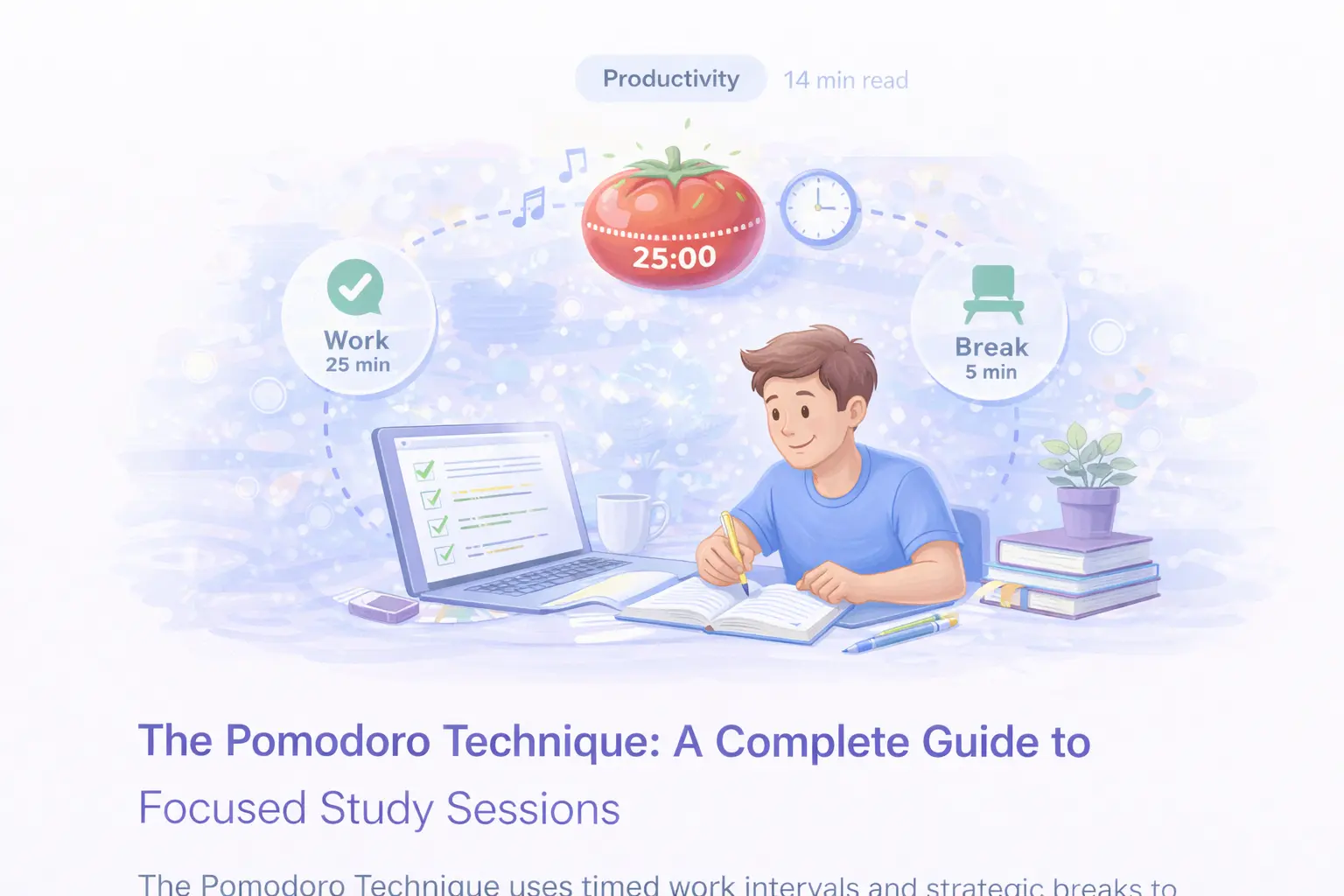
The Pomodoro Technique was developed by Francesco Cirillo in the late 1980s while he was a university student struggling with focus and productivity. He named it after the tomato-shaped kitchen timer he used ("pomodoro" is Italian for tomato).
The core method is simple:
- Choose a specific task to work on
- Set a timer for 25 minutes (one "pomodoro")
- Work with full focus until the timer rings
- Take a 5-minute break
- After 4 pomodoros, take a longer 15-30 minute break
What started as a personal hack has become one of the most widely adopted productivity techniques in the world, used by students, developers, writers, and professionals across industries. Its appeal lies in its simplicity—you can start using it immediately with nothing more than a timer.
Why does the Pomodoro Technique work according to cognitive science?
Attention is a limited resource
Research on sustained attention shows that focus quality degrades predictably over time. Studies using vigilance tasks find significant performance decline after 20-25 minutes of continuous concentration. The Pomodoro Technique respects this biological reality by building in recovery periods before attention depletes.
Timeboxing reduces procrastination
Procrastination often stems from task aversion—the perceived pain of starting something difficult. Research published in Psychological Science found that people are more willing to engage with unpleasant tasks when the commitment is time-limited. "Work on this for 25 minutes" feels dramatically more manageable than "finish this chapter," even if the actual work is the same.
Studies on the Pomodoro Technique specifically show that users report 40% less procrastination compared to their previous work habits. The fixed time commitment removes the open-ended dread that fuels avoidance.
Breaks enhance consolidation
Your brain continues processing information during rest periods. Neuroscience research shows that brief wakeful rest (like Pomodoro breaks) activates the same brain regions involved in memory consolidation during sleep. Strategic breaks aren't wasted time—they're when learning solidifies.
The technique exposes planning fallacy
Humans consistently underestimate how long tasks will take—a phenomenon called the planning fallacy. Studies show people underestimate task duration by 50% or more on average. Tracking pomodoros provides objective data on actual time spent, gradually improving estimation accuracy.
How do you implement the Pomodoro Technique step by step?
Step 1: Choose a single, specific task
Before starting, decide exactly what you'll work on. "Study biology" is too vague. "Read and take notes on Chapter 7" is specific. The clearer your task, the easier it is to maintain focus because your brain knows exactly what "success" looks like.
If a task is too large for one pomodoro, break it down. If it's too small, batch similar tasks together (answer emails, organize notes, review flashcards).
Step 2: Set your timer for 25 minutes
Use whatever timer works: a physical kitchen timer, your phone, a browser extension, or a dedicated app. The physical act of starting the timer signals to your brain that focused work has begun.
Critical rule: once started, the pomodoro cannot be paused. It's either completed or voided. This creates a clear commitment.
Step 3: Work with full focus until the timer rings
During the 25 minutes, work on your chosen task and nothing else. If a distracting thought arises (remembering an email, worrying about tomorrow, craving a snack), use the "inventory interrupt" technique:
- Write the thought down on a piece of paper (takes 3 seconds)
- Immediately return to your task
- Address the thought during your break or after your session
This captures the thought so your brain can release it, without derailing your focus.
Step 4: Take a 5-minute break when the timer rings
Stop working—even if you're in the middle of something. This feels counterintuitive, but the break is part of the system, not an interruption to it.
Effective break activities:
- Stand up and stretch
- Get water or a snack
- Walk to a window and look at something far away (reduces eye strain)
- Do a few deep breaths
Avoid activities that require cognitive engagement (social media, email, videos) as these prevent the mental reset the break provides.
Step 5: After 4 pomodoros, take a longer break
Every fourth cycle, take a 15-30 minute extended break. This is time for a real mental reset: a short walk, a meal, a conversation, or simply doing nothing. Your brain needs this recovery to maintain performance across longer study sessions.
How do you handle interruptions without breaking focus?
Internal interruptions (your own thoughts)
Internal interruptions are the thoughts that pull your attention away: remembering something you need to do, worrying about an upcoming event, or suddenly feeling hungry. These are the most common focus breakers.
The solution is the inventory system mentioned above. Keep a piece of paper next to you. When a thought intrudes, write it down in a few words ("call mom," "check assignment deadline," "hungry"). This takes about 3 seconds and allows your brain to release the thought knowing it won't be forgotten.
Many people discover that the same 3-4 thoughts repeatedly interrupt them. Identifying these patterns helps address the underlying concerns.
External interruptions (other people)
When someone interrupts you during a pomodoro, Cirillo recommends the "inform, negotiate, schedule, call back" strategy:
- Inform: "I'm in the middle of something right now"
- Negotiate: "Can this wait 15 minutes?"
- Schedule: If it can wait, note when you'll address it
- Call back: Follow through during your break
If the interruption is truly urgent or unavoidable, void the pomodoro (don't count it) and restart fresh later. Protect the integrity of completed pomodoros.
What variations of the Pomodoro Technique work for different situations?
The original 25/5 format isn't sacred. Research and practical experience suggest several effective variations:
52/17 Method
A productivity study by DeskTime found that their most productive users worked in 52-minute intervals followed by 17-minute breaks. This variation works well for tasks requiring deeper immersion, like writing or programming.
90-Minute Ultradian Cycles
Sleep researcher Nathaniel Kleitman discovered that humans cycle through periods of higher and lower alertness roughly every 90 minutes. Working in 90-minute blocks (followed by 20-30 minute breaks) aligns with this natural rhythm and works well for creative or analytical work.
Modified Pomodoro (30/6 or 45/10)
If 25 minutes feels too short, try 30-minute or 45-minute work periods with proportionally longer breaks. Many people find 30/6 or 45/10 hits their personal focus sweet spot.
Mini-Pomodoros (15/3)
When you're struggling to start or feeling particularly resistant, 15-minute intervals reduce the perceived barrier to entry. "Just 15 minutes" is almost impossible to refuse, and momentum often carries you into additional pomodoros.
Flexible breaks based on task
Some practitioners vary break length based on task difficulty: harder tasks get longer breaks (7-8 minutes), easier tasks get shorter ones (3-4 minutes). This provides more recovery when cognitive load is higher.
What mistakes sabotage the Pomodoro Technique?
- Skipping breaks to "stay in flow": This seems productive but leads to faster burnout and diminishing returns. The breaks are part of the system, not optional extras. Research shows sustained focus without breaks degrades performance by 20-30% over just a few hours.
- Using breaks for mentally demanding activities: Checking social media, reading emails, or watching videos during breaks prevents the mental reset. The break should feel restorative, not stimulating.
- Multitasking within pomodoros: Each pomodoro is for one task. Switching between tasks destroys the focus benefit and adds switching costs that can consume 15-25% of your productive time.
- Scheduling too many pomodoros: More pomodoros doesn't mean more productivity. Most people max out at 8-12 quality pomodoros per day. Beyond that, diminishing returns set in rapidly.
- Obsessing over perfect tracking: If you void a pomodoro or lose count, it's not a failure—just reset and continue. The technique should reduce stress, not create it.
How does the Pomodoro Technique combine with other study methods?
The Pomodoro Technique structures when and how long you study. Other methods determine what you do during that time. Combining them creates a complete study system:
Pomodoro + Active Recall
Use pomodoros for active recall sessions: one pomodoro for flashcard review, one for practice problems, one for the blank page method. The timed structure prevents the common mistake of passive review disguised as studying.
Pomodoro + Spaced Repetition
Schedule regular pomodoros dedicated to spaced repetition review. One 25-minute session per day for flashcard review is often enough to maintain thousands of cards once the system is established.
Pomodoro + Feynman Technique
Use a single pomodoro to explain a concept using the Feynman Technique. The time constraint forces you to identify what you actually understand versus what you're hand-waving through.
Pomodoro + Deep Work
For complex tasks requiring sustained immersion, chain 3-4 pomodoros together (still taking the short breaks) before the long break. This creates a 2-hour "deep work block" with built-in recovery periods.
How do you build a consistent Pomodoro habit?
- Start with 3-4 pomodoros per day: Don't try to transform your entire schedule immediately. Build the habit first, then expand.
- Anchor to existing routines: "After my morning coffee, I do 2 pomodoros" is more likely to stick than "I'll do pomodoros sometime in the morning."
- Track your pomodoros: Simple tracking (hash marks on paper, a tally app) provides motivation and data. Seeing your count grow is surprisingly satisfying.
- Review weekly: How many pomodoros did you complete? What tasks took more or fewer than expected? Use this data to improve planning.
- Be flexible: Some days you'll complete 8 pomodoros easily. Other days, 2 will feel like a victory. Both are fine. Consistency across weeks matters more than daily performance.
When might the Pomodoro Technique not be the best fit?
The technique isn't universal. Consider alternatives for:
- Genuine flow states: If you're deeply immersed in creative or analytical work and time is flying by, interrupting with a forced break can be counterproductive. Some practitioners pause the pomodoro system when flow emerges naturally.
- Collaborative work: Real-time collaboration with frequent discussions doesn't fit the focused-interval model. Use pomodoros for individual prep work, then free-form for collaboration.
- Very short tasks: If everything you need to do takes 5-10 minutes, batching makes more sense than individual pomodoros.
- Learning environments with external structure: In a lecture, lab, or meeting, external timing constraints already exist. Apply pomodoros to your own study time instead.
Wrap up
The Pomodoro Technique works because it respects how your brain actually functions rather than pretending willpower is unlimited. Attention degrades after 20-25 minutes. Breaks enhance consolidation. Time constraints reduce procrastination. The technique builds on all of these realities.
Start simple: one task, one timer, 25 minutes. Take your break. Repeat. You'll likely find that focused 25-minute sessions accomplish more than scattered hours of "studying." Once the habit is established, experiment with variations to find what works best for your tasks and attention patterns.
The goal isn't to become a productivity robot—it's to create a sustainable system that helps you study effectively without burning out. Thousands of students and professionals have found that system in the Pomodoro Technique. A tomato-shaped timer might be the simplest tool that makes the biggest difference.
Frequently Asked Questions
How long should a Pomodoro study session be?
What should I do during Pomodoro breaks?
How many Pomodoros can I realistically complete per day?
Related articles
Continue learning with these related posts.


Put these techniques into practice
Upload your study materials and let Laxu AI create flashcards, notes, and quizzes automatically.