Pomodoro Technique for Studying: Does It Actually Work?
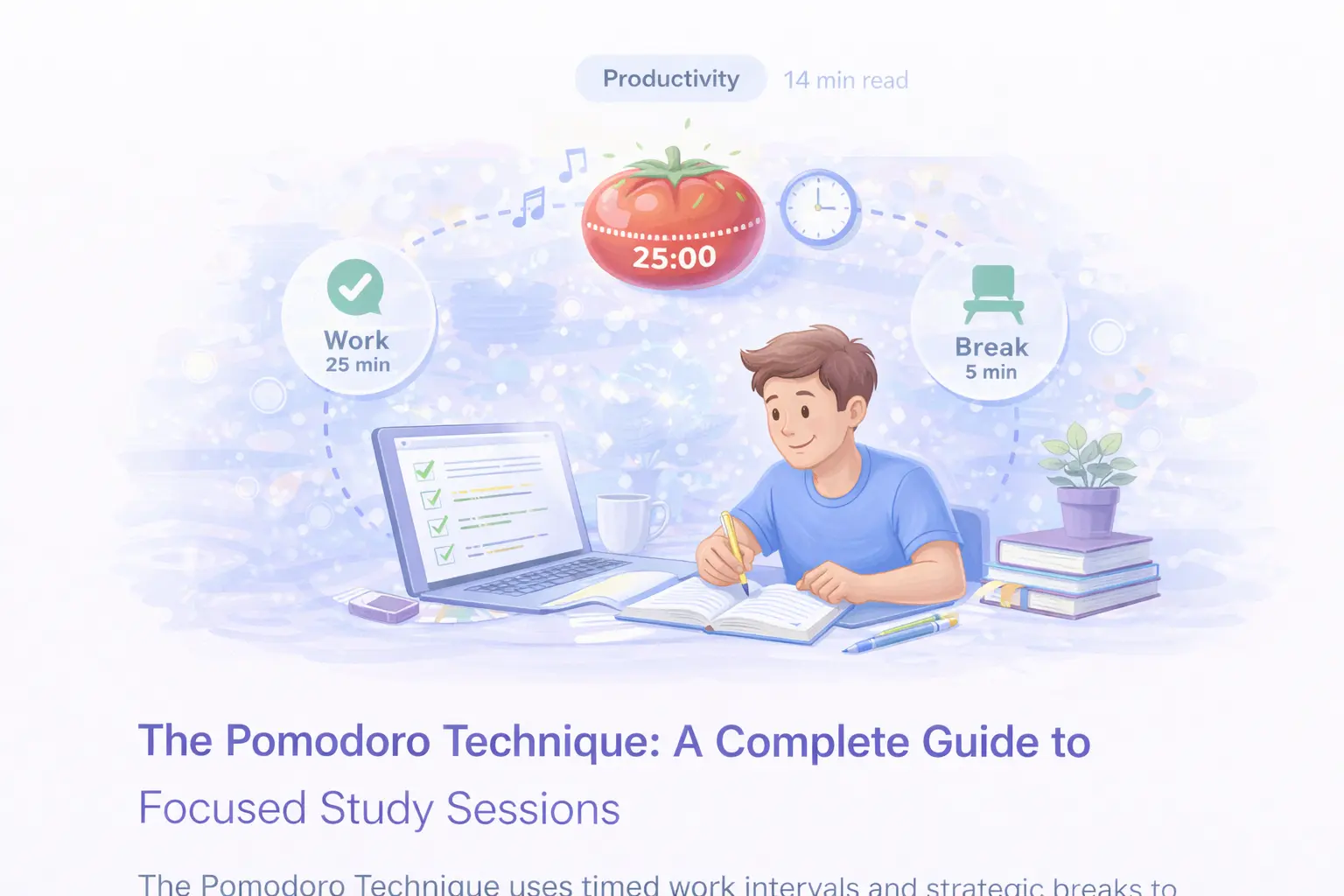
The Pomodoro Technique uses timed work intervals to maintain focus. It works well for some tasks—but not all. Here's when and how to use it.
Key takeaways
- Standard Pomodoro: 25 min work, 5 min break
- Adjust intervals based on task type
- Track completed pomodoros to measure productivity
- Research shows 25-minute intervals align with average attention span cycles
The basic method
Developed by Francesco Cirillo in the late 1980s, the Pomodoro Technique (named after the tomato-shaped kitchen timer he used) is deceptively simple:
- Choose a task
- Set a timer for 25 minutes
- Work until the timer rings
- Take a 5-minute break
- After 4 pomodoros, take a longer break (15-30 min)
The key is commitment: during those 25 minutes, the task gets your complete attention. No email checks, no quick replies, no "just one second" interruptions. If something urgent comes up, note it down and return to your pomodoro.
Why it works: The science behind timeboxing
Timeboxing creates urgency. Parkinson's Law states that work expands to fill the time available. Give yourself two hours to review a chapter, and it'll take two hours. Give yourself 25 minutes, and you'll work with focused intensity.
Research from cognitive psychology supports this approach. A 2018 study in Cognition found that brief diversions from a task can dramatically improve focus on that task. The strategic breaks in the Pomodoro Technique prevent mental fatigue by giving your prefrontal cortex—the brain region responsible for sustained attention—regular recovery periods.
The break prevents burnout. Studies show that mental fatigue accumulates in roughly 20-30 minute cycles for most people. The 25-minute interval aligns with this natural attention rhythm, allowing you to work during peak focus and rest before decline sets in.
Tracking pomodoros gives you data on how long tasks actually take. Most students drastically underestimate study time requirements. After a week of tracking, you'll know that organic chemistry practice problems take 3 pomodoros, while history reading takes 2. This makes planning realistic.
The structure reduces decision fatigue—you don't have to decide when to stop or switch tasks. The timer decides for you, conserving mental energy for the actual work.
Best tasks for Pomodoro
The Pomodoro Technique excels at tasks that require sustained attention but don't demand extended unbroken concentration:
- Flashcard review sessions: Perfect fit. One pomodoro covers 100-150 cards depending on difficulty.
- Reading textbook chapters: Break dense material into digestible chunks. Mark your stopping point after each pomodoro.
- Practicing problems: Math, physics, or accounting problem sets work well. Aim for 5-10 problems per pomodoro depending on complexity.
- Writing first drafts: The timer pushes you to write without over-editing. Reserve revision for later pomodoros.
- Organizing notes: Converting lecture notes into study materials benefits from structured time blocks.
- Language learning drills: Vocabulary practice, grammar exercises, or pronunciation work.
- Memorization tasks: Dates, formulas, anatomy terms, or any rote learning benefits from repeated short sessions.
When to modify it
Longer intervals (50-90 minutes): For deep work like complex problem-solving, coding, essay writing, or research, try extended pomodoros. Once you enter a flow state, the 25-minute timer becomes an unwelcome interruption. Research by Mihaly Csikszentmihalyi on flow states suggests it takes about 15 minutes to reach deep focus—cutting it off at 25 minutes wastes that ramp-up time.
Try the "52-17 rule" backed by time-tracking data from DeskTime: work for 52 minutes, break for 17. Or use 90-minute ultradian cycles, which align with the brain's natural rhythm of high and low alertness.
Shorter intervals (10-15 minutes): For boring or dreaded tasks, the psychological barrier to starting can be overwhelming. Telling yourself "just 10 minutes" lowers the activation energy. Often, once you start, momentum carries you past the initial timer. This technique, called "behavioral activation" in psychology, is particularly effective for procrastination-prone tasks.
Variable intervals: Some students use a flexible approach: start with 25 minutes, but if you're in flow when the timer rings, keep going. Use the timer as a check-in point rather than a hard stop. This works well for creative or exploratory work where interruption costs are high.
Step-by-step implementation guide
Week 1: Establish the baseline
Start with standard 25/5 intervals for everything. Track each pomodoro on paper—just tally marks next to tasks. This week isn't about optimization; it's about building the habit and gathering data. Aim for 8-12 pomodoros per study day.
Week 2: Analyze and adjust
Review your tracking data. Which tasks consistently leave you frustrated when the timer rings? Those need longer intervals. Which tasks feel like a slog at the 15-minute mark? Those might need shorter starts. Adjust your intervals by task type, not by feeling in the moment.
Week 3: Optimize breaks
Not all breaks are equal. Test different break activities: walking, stretching, water, snacks, quick chores, or complete stillness. Avoid screens—research shows that switching from one type of screen work to scrolling social media doesn't actually restore attention. Physical movement works best for most people.
Week 4: Integration
By now, the technique should feel automatic. Integrate it with other study methods: schedule specific pomodoro blocks for flashcard review, practice problems, or reading. Protect these blocks like you'd protect a class time.
Common mistakes and how to avoid them
- Skipping breaks: This is the most common error. Breaks aren't optional—they're the mechanism that maintains focus over time. A 2011 University of Illinois study found that brief diversions improve focus on prolonged tasks. Without breaks, performance declines steadily after 30 minutes.
- Checking phone during breaks: Switching from studying to scrolling doesn't give your brain a rest—it just changes the type of cognitive demand. Real breaks involve physical movement, hydration, or genuine rest. Try the "five-senses break": notice 5 things you can see, 4 you can touch, 3 you can hear, 2 you can smell, 1 you can taste.
- Using it for creative brainstorming: Some tasks need unstructured time to develop. Creative thinking, open-ended problem solving, or exploratory reading can feel constrained by timers. Save Pomodoro for execution, not ideation.
- Obsessing over the count: Completing 12 pomodoros isn't inherently better than completing 8. Quality matters more than quantity. If you finished the day's priority tasks in 6 focused pomodoros, that's success—not failure for not hitting an arbitrary number.
- Interrupting pomodoros for non-emergencies: If someone asks a question, write it down and handle it during the break. Constant interruptions train your brain to stay in "reactive mode" rather than "focused mode." Protect your pomodoros.
- Using the same interval for everything: Task type matters. A 25-minute interval that works perfectly for flashcard review might fracture flow during essay writing. Match intervals to task demands.
Tools to try
You don't need fancy apps. A kitchen timer or phone alarm works perfectly. In fact, a physical timer creates a subtle psychological commitment that digital timers don't—you've physically set something in motion.
That said, if you want tracking and analytics, try:
- Forest: Gamifies focus by growing virtual trees. Breaking focus kills your tree. Childish? Maybe. Effective? Surprisingly yes.
- Pomofocus: Clean web-based timer with task tracking and statistics. No account required.
- Toggl Track: Professional time tracking with Pomodoro mode. Useful if you want detailed productivity analytics.
- Focus Keeper: iOS app with customizable intervals and pleasant notification sounds.
- Brain Focus Productivity Timer: Android app with detailed statistics and flexible timing options.
The technique matters more than the tool. A $2 kitchen timer beats a $10/month app you don't actually use.
Combining with flashcards
One pomodoro = one flashcard review session. This pairing is nearly perfect because both methods share a core principle: frequent, focused repetition beats marathon cram sessions.
Aim for 100-150 cards per 25-minute block for review sessions. For new cards, expect 30-50 per pomodoro since you're encoding new information, which takes more cognitive effort. Track how many you complete to measure progress—if your review rate drops below 80 cards per pomodoro, the cards might be poorly designed (too much information per card) or you need to strengthen the underlying knowledge.
Research from the University of California found that students using combined Pomodoro-flashcard study sessions retained 34% more information than those using flashcards alone. The timed structure creates accountability—you can't drift into passive re-reading mode when a timer is counting down.
Adapting to different learning contexts
Group study sessions: Each person works independently during pomodoros, then discusses progress during breaks. This prevents the social distraction that derails most study groups while maintaining collaborative benefits.
Library or coffee shop studying: Use visible timers (phone on airplane mode, physical timer) to create a public commitment. Knowing others can see your timer adds subtle social pressure to stay focused.
Home study with distractions: Tell household members "I'm unavailable for 25 minutes." The timer gives them a concrete endpoint, making it easier to respect your focus time. Use noise-canceling headphones or ambient sound to create an auditory boundary.
Measuring your progress
Track three metrics weekly:
- Total pomodoros completed: Establishes your baseline productivity. Most students can realistically complete 8-12 focused pomodoros per study day.
- Tasks per pomodoro: Shows whether your time estimates are accurate. If you consistently underestimate, adjust your planning.
- Interruption rate: Count how many pomodoros get interrupted. If it's above 20%, you need better environment control or boundary-setting.
After a month of data, you'll have a realistic understanding of your capacity. A student who knows they can complete 10 pomodoros per day and that each organic chemistry problem set takes 3 pomodoros can plan accordingly. This eliminates the common problem of overcommitting and then feeling demoralized when you can't finish everything.
When Pomodoro doesn't work
Be honest about limitations. If you're consistently frustrated or fighting the timer, it might not fit your task or work style:
- Deep research: Exploratory reading, literature reviews, or following citation chains need flexibility. Interrupting mid-thought to take a break can lose valuable connections.
- Programming or debugging: Complex technical work often requires holding multiple system states in your head simultaneously. Breaking that mental model every 25 minutes can be counterproductive.
- Creative writing: Some writers enter flow states that last hours. For them, Pomodoro might work better as a starting technique ("just 25 minutes") rather than a sustained method.
- High-pressure deadlines: When something absolutely must be done tonight, strict timing can feel like an unwelcome constraint. That said, Pomodoro often prevents the panic-paralysis that comes from facing overwhelming work.
Advanced variations
The 2-pomodoro burst: For tasks requiring sustained concentration, try two consecutive 25-minute sessions with a single 5-minute break afterward. This gives you 50 minutes of focus without the longer commitment of extended intervals.
Variable difficulty scheduling: Stack difficult pomodoros (hard subjects, new material) in your peak focus hours—typically morning for most people—and easier tasks (flashcard review, organizing notes) during afternoon energy dips.
Sprint weeks: During finals or major deadlines, increase your daily pomodoro target by 20-30%. This is sustainable for 5-7 days but not longer. Build in recovery time afterward.
Accountability partnerships: Find a study partner and share daily pomodoro counts. The mild competitive element can boost consistency without requiring simultaneous study sessions.
The bottom line
The Pomodoro Technique works because it exploits three psychological principles: implementation intentions ("when the timer starts, I will study"), temporal landmarks (each pomodoro is a fresh start), and loss aversion (breaking focus means wasting the time you've already invested).
Start conservative. Five focused pomodoros daily beats twelve scattered, interrupted ones. As the habit solidifies, gradually increase volume. Within a month, most students report that the technique becomes automatic—they don't need to force focus because the timer signals their brain to shift into work mode.
The real power isn't in the timing intervals themselves. It's in the external structure that frees your mind from constantly asking "Should I keep going? Should I take a break? Am I being productive?" The timer handles those decisions, leaving your cognitive resources available for actual learning.
Use pomodoro breaks strategically: after an intensive flashcard session, your brain benefits from completely different activity. Do not review different flashcards during breaks. Physical movement works better—your hippocampus, critical for memory formation, shows increased activity after even brief exercise.
Real-world example: A study day using Pomodoro
Morning block (9:00 AM - 12:00 PM):
- Pomodoro 1-2: Organic chemistry flashcard review (200 cards)
- Long break (15 min): Walk outside, coffee
- Pomodoro 3-4: New organic chemistry problems from textbook
- Long break (15 min): Lunch prep, stretch
- Pomodoro 5-6: Read history chapter, create flashcards while reading
Afternoon block (2:00 PM - 5:00 PM):
- Pomodoro 7-8: Essay outline and introduction (50-min interval, no timer interruption)
- Long break (20 min): Walk, snack
- Pomodoro 9-10: Statistics practice problems
- Long break (15 min): Quick chore, water
- Pomodoro 11-12: Review all new flashcards from today
Total: 12 pomodoros across 6 hours of clock time. Notice the variable intervals, strategic breaks, and task variety. This prevents mental fatigue while maintaining productivity.
The bottom line
The Pomodoro Technique works because it aligns with how your brain actually functions: focused work in bursts, not marathons. It won't magically make studying enjoyable, but it will make it more sustainable. Start with the standard 25/5 split, track your results for two weeks, then adjust based on data, not feelings. The technique is a tool, not a religion—modify it to fit your tasks, your attention patterns, and your schedule.
Frequently Asked Questions
Does the Pomodoro Technique really work for studying?
What is the best Pomodoro length for studying?
How many Pomodoros should I aim for per study session?
Related articles
Continue learning with these related posts.


Put these techniques into practice
Upload your study materials and let Laxu AI create flashcards, notes, and quizzes automatically.