How to Use an AI Quiz Generator to Actually Pass Your Exams

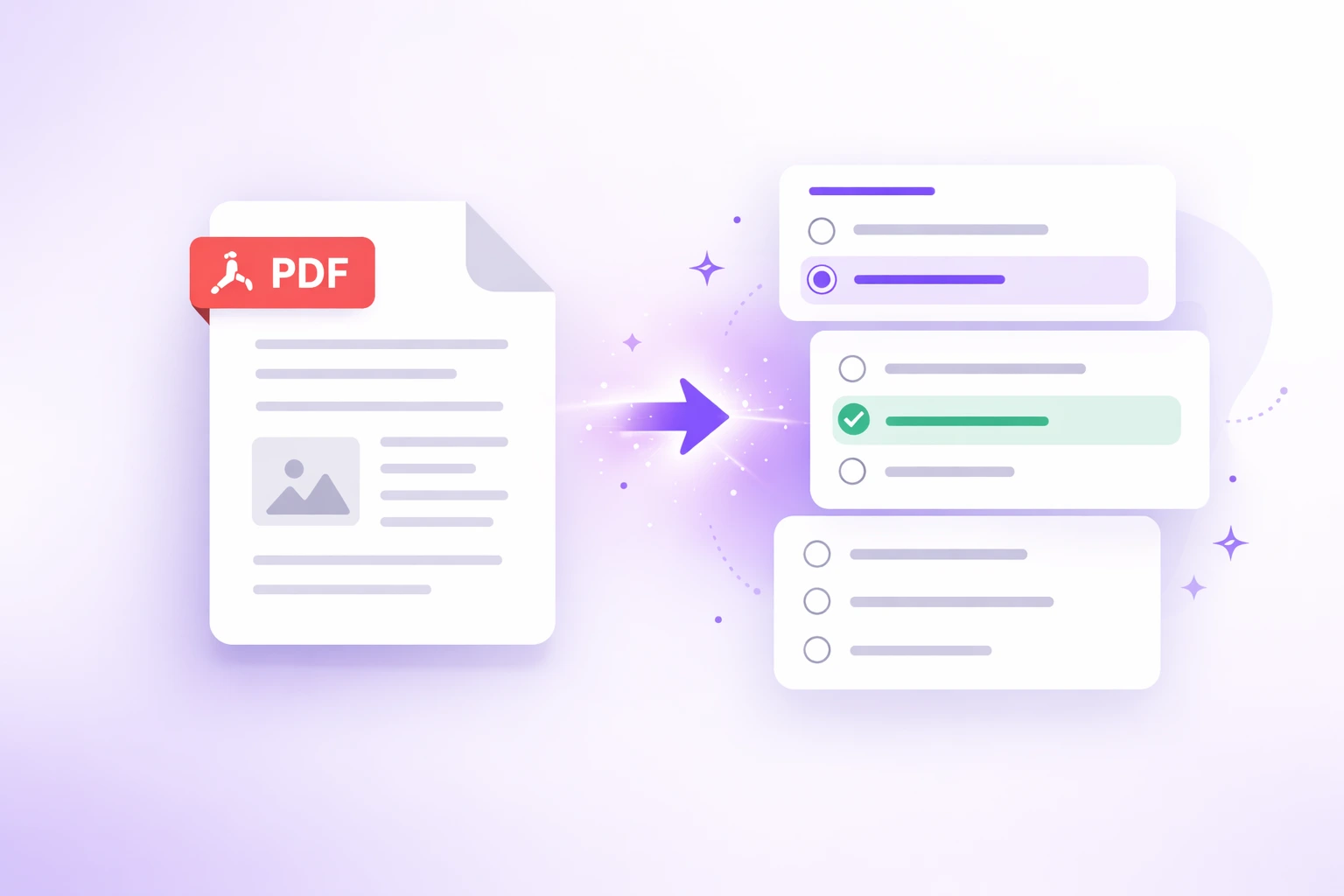
You've probably heard of AI quiz generators by now—tools that take your notes or PDFs and turn them into practice tests. But most students use them wrong. They generate a quiz, skim through the answers, and move on. That's not studying. This guide shows you how to use an AI quiz generator in a way that actually improves your exam scores.
Laxu AI is a free AI quiz generator that creates practice tests from PDFs, images, and audio in under 2 minutes. It generates multiple choice, true/false, and fill-in-the-blank questions with answer explanations—plus flashcards and notes from the same upload.
What you'll learn
- Why practice testing works better than rereading (the research)
- How to generate quizzes from PDFs, notes, images, and audio
- The right way to review wrong answers
- How to combine quizzes with flashcards and spaced repetition
- A 5-day exam prep plan using AI quizzes
Why practice testing beats everything else
In 2013, Dunlosky and colleagues published a landmark meta-analysis in Psychological Science in the Public Interest that reviewed decades of research on study techniques. Their finding: practice testing and distributed practice (spacing) were the only two techniques rated as having "high utility."
Everything else—highlighting, rereading, summarizing, keyword mnemonics—was rated low to moderate. Not useless, but not nearly as effective as actually testing yourself.
Here's why practice testing works so well:
- Retrieval strengthens memory. When you try to pull an answer from memory (even if you fail), you create stronger neural connections than when you passively read the answer. This is called the "testing effect."
- It reveals what you don't know. Re-reading your notes gives you a false sense of confidence. Everything looks familiar. A quiz shows you exactly what you can and can't recall—before the real exam does.
- It mimics the exam environment. Practicing under test-like conditions (timed, no notes, multiple choice) reduces test anxiety and improves performance on the actual exam. Psychologists call this "transfer-appropriate processing."
The problem was always time. Writing a full set of practice questions by hand - reading back through the material, deciding what is testable, drafting plausible wrong answers - is an evening's work, not a coffee break. We have not timed that across students, so treat any specific number you see for it as a guess, ours included. An AI quiz generator collapses it to a couple of minutes, which is what removes the bottleneck and lets you practice test every study session.
How AI quiz generators actually work (and how to prompt for better questions)
I build generative AI products for a living, so I want to demystify what's happening when you click "generate quiz" — and what you can do about the parts that disappoint you. Under the hood, almost every AI quiz generator runs the same two-step pipeline:
Step 1: Extract the content. Your PDF, image, or audio gets converted into structured text. For PDFs that means OCR on any image-based pages, paragraph and heading detection, table extraction. For audio it means a transcription model (Whisper-class) outputting timestamped text. This step is where most quality is silently won or lost — if extraction misses a table or garbles section headings, the model can't ask about content it never received.
Step 2: Generate questions. The extracted text gets sent to a language model with a prompt that says, essentially: "Here is the source material. Produce N multiple-choice questions with one correct answer and three plausible distractors. Include an explanation." The model then writes the quiz.
Where this pipeline fails predictably:
- Generic distractors. Writing good wrong answers is harder than writing right answers. Smaller models will give you obviously-wrong options ("the Eiffel Tower" for a biology question) instead of options that are wrong in instructive ways. If your quiz has joke-tier distractors, the tool is using a cheaper model.
- Coverage decay on long documents. Most quiz tools sample a few sections of a long PDF rather than reasoning across the whole document. You'll get five questions from chapter one, three from chapter two, and nothing from chapters three through six. Check coverage before you trust the quiz as comprehensive prep.
- Question difficulty doesn't match its label. Tools that offer "easy / medium / hard" settings are usually changing the prompt with the word "harder" — they're not modeling cognitive depth. You'll often see a "hard" quiz that's just longer questions with the same recall-level demand.
- Definition-only questions. Out-of-the-box, models lean heavily toward "What is X?" recall questions because those are the easiest to grade. Application, comparison, and edge-case questions require more reasoning to generate and most tools don't push for them.
What you can do as a student to get better quizzes:
- Be specific in the prompt if the tool exposes one. "Generate 20 application-level questions about scenarios where the concept matters" beats "make a quiz". Most tools have a free-text instruction box buried in advanced options — use it.
- Split long documents. If you have a 100-page reader, don't upload it whole. Upload chapter by chapter so each section gets dedicated question budget.
- Mix question types intentionally. If the tool lets you toggle multiple choice, true/false, and short answer, use all three. Mixed-format quizzes test understanding better than uniform recall.
- Regenerate if the first batch is bad. Models are nondeterministic — the same input produces different outputs each run. If the first quiz is heavy on definitions, regenerate; you might get a more varied second pass.
The tool is doing what you ask it to do. If you ask for nothing, you'll get the default — which is usually the cheapest, most generic question type the model can produce.
How to generate a quiz with AI (step by step)
Step 1: Choose your source material
The quality of your quiz depends entirely on the quality of your source material. Here's what works best:
- Lecture slides (PDF): The most directly exam-relevant material. Your professor wrote these slides, and the exam is based on them. Always start here.
- Textbook chapters (PDF): Good for deeper understanding and additional context. Upload the specific chapters assigned, not the entire textbook.
- Handwritten notes (image): Take a clear photo of your notes. AI tools with OCR (like Laxu AI) can read handwriting and generate questions from it.
- Lecture recordings (audio): If you record lectures, upload the audio file. The AI transcribes it and generates questions from the spoken content. Great for capturing details your professor emphasized verbally.
Pro tip: Upload lecture slides AND the corresponding textbook chapter as separate uploads. This gives you two different sets of questions on the same topic—one from the professor's perspective and one with textbook-level detail.
Step 2: Generate and review the quiz
After uploading, most AI quiz generators produce results in under 2 minutes. Before jumping into the quiz, spend 60 seconds reviewing the questions:
- Are the questions relevant to what you need to study?
- Do any questions seem factually incorrect? (AI isn't perfect—delete these.)
- Are there questions covering topics your professor explicitly said won't be on the exam? (Remove these to focus your time.)
This quick quality check takes a minute but ensures you're studying the right material.
Step 3: Take the quiz without your notes
This is the most important step, and it's where most students cheat themselves. Close your notes. Close your textbook. Close your slides. Take the quiz from memory.
It will feel uncomfortable. You'll want to peek. Don't. The struggle to remember is exactly what creates learning. A 2009 study by Kornell, Hays, and Bjork showed that even failed retrieval attempts improve subsequent learning—trying and failing is better than not trying at all.
If you don't know an answer, make your best guess. The act of guessing and then seeing the correct answer creates a stronger memory trace than simply reading the answer directly.
Step 4: Review your mistakes (the right way)
After finishing the quiz, most students look at their score and move on. This is where they leave 80% of the learning value on the table. Here's how to review properly:
- For each wrong answer: Read the explanation carefully. Don't just note the correct answer—understand why it's correct and why your choice was wrong.
- Categorize your mistakes: Did you get it wrong because you didn't know the concept at all? Because you confused two similar concepts? Because you misread the question? Each type of mistake requires a different fix.
- Create flashcards from your mistakes. Turn each wrong answer into a flashcard. The question goes on the front, the correct answer with explanation on the back. These become your priority review cards.
- Retake the quiz the next day. Don't retake it immediately—that just tests short-term memory. Wait 24 hours, then try again. This spaced repetition approach ensures the corrections stick.
Which question types to focus on
AI quiz generators typically create several types of questions. Each tests a different level of understanding:
- Multiple choice (MCQ): Tests recognition and elimination skills. Good for factual recall and distinguishing between similar concepts. Focus on these if your exam is MCQ-based.
- True/false: Tests whether you can evaluate statements for accuracy. Good for catching misconceptions. These seem easy but often reveal gaps in understanding.
- Fill-in-the-blank: Tests pure recall—no options to choose from. This is harder than MCQ and creates stronger memory traces. Use these for definitions, formulas, and key terms.
- Short answer: Tests deeper understanding and ability to explain. Best for essay-style exams where you need to articulate concepts in your own words.
Match your practice to your exam format. If your professor gives MCQ exams, focus on MCQ practice. If it's essay-based, focus on short answer. Practicing in the same format as the exam improves performance through transfer-appropriate processing.
The 5-day AI quiz exam prep plan
Here's a structured plan for using an AI quiz generator to prepare for an exam, starting 5 days before:
Day 5 (5 days before exam)
Upload all your lecture PDFs and key textbook chapters. Generate quizzes from each. Take each quiz without notes and record your scores. Identify your three weakest topics based on wrong answers. Time: 45 minutes.
Day 4
Focus on your weakest topics. Re-read the relevant material for these topics only (targeted review, not blind rereading). Then retake the quizzes for those topics. Did your scores improve? Create flashcards from any remaining wrong answers. Time: 40 minutes.
Day 3
Take all quizzes again—every topic. Compare scores to Day 5. Review flashcards from wrong answers using spaced repetition. Generate a second round of quizzes from the same material (AI tools produce different questions each time). Take these fresh quizzes. Time: 50 minutes.
Day 2
Focus exclusively on wrong answers and difficult flashcards. Re-take quizzes for topics where your score is still below 80%. Review all flashcards one more time. Time: 30 minutes.
Day 1 (day before exam)
Final pass through all quizzes—timed, no notes, simulating exam conditions. Review any final wrong answers. Quick scan of flashcards. Then stop. Sleep is more important than last-minute cramming. Time: 30 minutes.
Total study time: ~3 hours across 5 days
Compare this to the typical approach of rereading notes for 6-8 hours the night before. The AI quiz approach is shorter, more effective, and produces less stress because you know exactly what you know and don't know.
Combining quizzes with flashcards and notes
The most effective study approach combines all three AI-generated outputs:
- Start with AI notes/summary — get an overview of the material structure and main concepts. This is your roadmap.
- Study flashcards — build recall of individual facts, definitions, and concepts. The spaced repetition algorithm ensures efficient review.
- Take AI quizzes — test your ability to apply knowledge, distinguish between concepts, and handle exam-format questions.
This three-layer approach covers understanding (notes), recall (flashcards), and application (quizzes). With tools like Laxu AI, you get all three from a single upload—no extra work required. And you can manually create additional flashcards for edge cases or professor-specific details that the AI might miss.
Which subjects benefit most from AI quizzes?
AI quiz generators work best with content that has clear, testable answers. Here's how different subjects fare:
Sciences (biology, chemistry, physics) — Excellent
Science courses are built on facts, processes, and definitions—exactly what AI excels at testing. Upload a biology chapter on cellular respiration and you'll get questions about ATP production, the electron transport chain, and glycolysis that closely match what you'd see on the actual exam. The MCQ format mirrors most science exams perfectly.
Medical and nursing — Excellent
Medical students generate thousands of flashcards per semester. Using an AI quiz generator from your anatomy or pharmacology PDFs creates instant practice boards. Pair with manual flashcards for clinical reasoning questions that require deeper application.
History and social sciences — Very good
Dates, events, figures, and cause-and-effect relationships are highly testable. AI quizzes work well for the factual component. For essay-format exams, use the short-answer question type to practice constructing arguments.
Law — Good (with manual supplements)
AI can test legal rules, case holdings, and statutory elements effectively. But law school exams are often essay-based hypotheticals. Use AI quizzes for rule recall, then manually add practice hypotheticals to your study deck.
Languages — Good for vocabulary and grammar
Upload vocabulary lists or grammar chapters and get instant quiz questions. Works particularly well for Spanish, French, German, and other languages with structured grammar rules. Less useful for conversation practice.
Mathematics — Limited
Math is more about solving problems than recalling facts. AI quizzes can test formulas and definitions, but can't replicate the step-by-step problem-solving that math exams require. Use AI quizzes for the conceptual/definitional parts and manual practice for computation.
AI quiz generators compared
Not all AI quiz generators are equal. Here's how the top options compare for quiz-specific features:
| Feature | Laxu AI | Studocu | Quizlet | Knowt |
|---|---|---|---|---|
| Generate quiz from PDF | Yes | Basic | No | Yes |
| Generate quiz from image | Yes | No | No | No |
| Generate quiz from audio | Yes | No | No | No |
| Multiple choice | Yes | Yes | Yes | Yes |
| True/false | Yes | Yes | Yes | Yes |
| Fill-in-the-blank | Yes | No | No | Yes |
| Answer explanations | Yes | Partial | No | Partial |
| Also generates flashcards | Yes | Basic | No | Yes |
| Also generates notes | Yes | Summaries | No | No |
| AI tutor | Yes | No | No | No |
| Free tier | Yes (1 upload) | Yes (limited) | Limited | Yes |
| Price (paid) | $4.99/mo | $9.99/mo | $7.99/mo | $5.99/mo |
Common mistakes to avoid
- Taking quizzes with your notes open. This tests reading comprehension, not memory. Close everything and rely on your brain.
- Only generating quizzes once. Generate multiple rounds from the same material. AI produces different questions each time, giving you broader coverage.
- Ignoring wrong answers. Your mistakes are the most valuable data you have. Each wrong answer tells you exactly what to study next.
- Cramming all quizzes into one session. Space them across days. Three 30-minute sessions beat one 90-minute session every time.
- Not practicing in exam format. If your exam is multiple choice, practice with multiple choice. Format familiarity reduces test anxiety.
The bottom line
An AI quiz generator isn't magic—it's a tool that removes the bottleneck between your study material and practice testing. The learning still happens in your brain, through retrieval practice, mistake analysis, and spaced repetition.
But by eliminating the hours of manual question-writing, you can practice test yourself on every lecture, every chapter, every study session. That's the real advantage: not that the questions are AI-generated, but that you can test yourself so much more often.
Start here
Upload one PDF to Laxu AI's quiz generator. Take the quiz without your notes. Review your mistakes. That single session will teach you more about your exam readiness than 3 hours of rereading ever could.
Frequently Asked Questions
How do I generate a quiz from a PDF?
Are AI-generated quiz questions accurate?
How many practice quizzes should I take before an exam?
Is an AI quiz generator better than making my own practice questions?
Related articles
Continue learning with these related posts.

Put these techniques into practice
Upload your study materials and let Laxu AI create flashcards, notes, and quizzes automatically.