How to Memorize Faster: Science-Backed Techniques
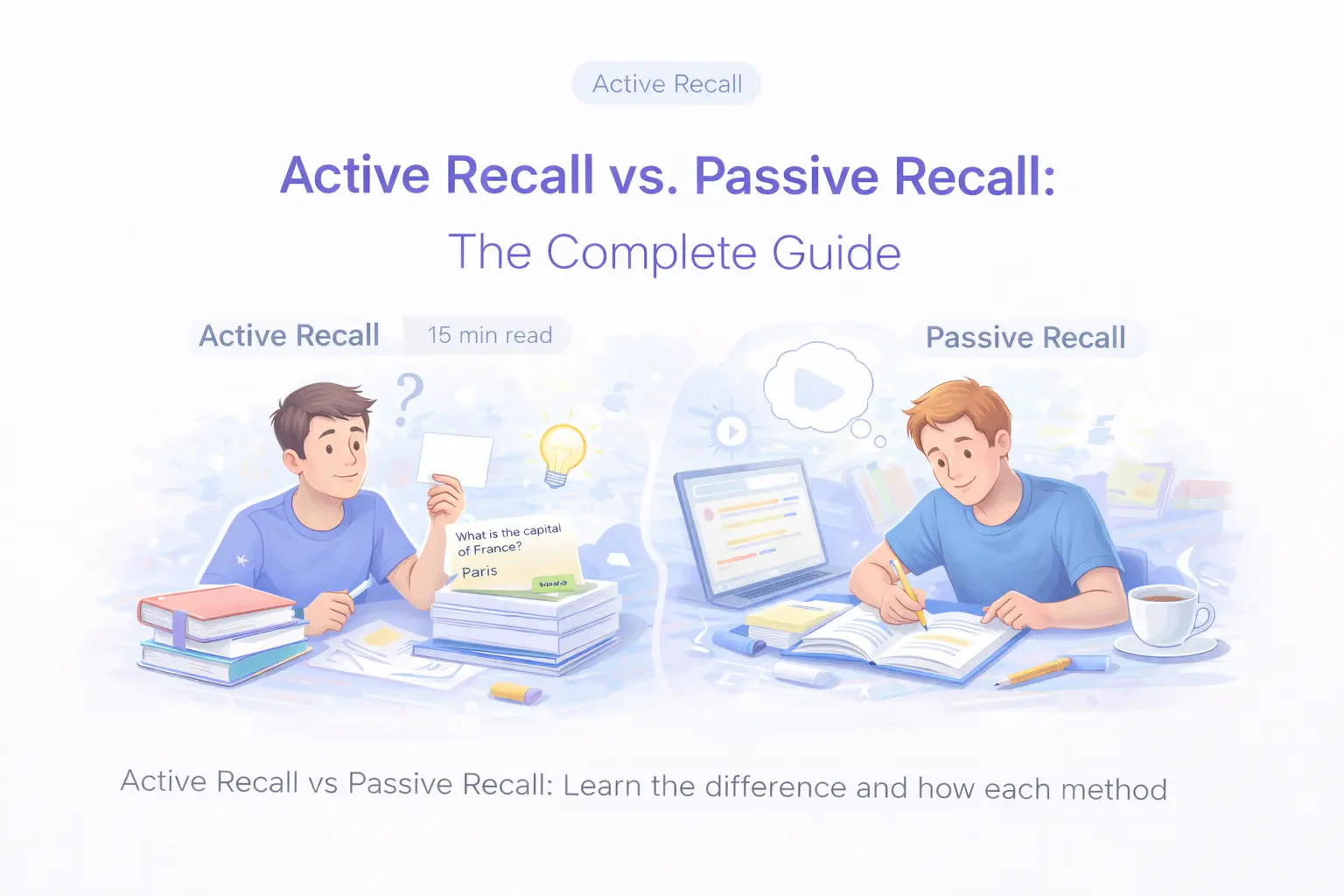
Memorization isn't about repetition—it's about encoding. The techniques that work fastest are the ones that create stronger memory traces.
Key takeaways
- Active recall beats passive review
- Spaced practice prevents forgetting
- Associations make new information stick
Active recall: Test yourself instead of rereading
Looking at information doesn't strengthen memory. Retrieving it does. Every time you pull a fact from memory, you reinforce the neural pathway. This is called the "testing effect," and it's one of the most robust findings in cognitive psychology.
In a 2008 study in Science, Karpicke and Roediger had students learn Swahili vocabulary. Students who kept testing themselves on every word remembered about 80% of the list a week later. Students who dropped each word from testing once they had recalled it correctly remembered about a third. Repeated studying without testing made no difference.
The mechanism is counterintuitive: struggling to remember something—even if you fail initially—creates stronger memory traces than passively seeing the answer. Your brain treats retrieval attempts as signals that this information is important and worth strengthening.
How to implement:
- Use flashcards, but don't flip the card too quickly. Spend 5-10 seconds trying to recall before checking.
- After reading a textbook section, close it and write everything you remember. Then check what you missed.
- Practice questions are better than reading summaries. Even if you get questions wrong, the retrieval attempt helps.
- Use the Feynman Technique: explain concepts aloud as if teaching someone. When you get stuck, you've found a gap.
- Create practice tests for yourself. The act of answering questions is superior to the act of creating them.
- Making the cards is the slow part. If you upload the chapter to Laxu AI instead, the notes come back in about 40 seconds and a PDF yields about 39 cards (medians across 907 PDF and Word uploads in the 30 days to 9 October 2026), which leaves your time for the recall itself.
Spaced repetition: The forgetting curve fix
Cramming creates weak memories that fade fast. When you review something 10 times in one day, the 8th, 9th, and 10th reviews add almost nothing—you already know it short-term. Spacing those same 10 reviews over days and weeks builds durable long-term recall.
In his 1885 experiments on himself, Hermann Ebbinghaus had forgotten about two thirds of a list of nonsense syllables within a day; a 2015 replication reproduced his curve closely. Each successful review flattens the curve. After 4-5 well-timed reviews, information can last months or years.
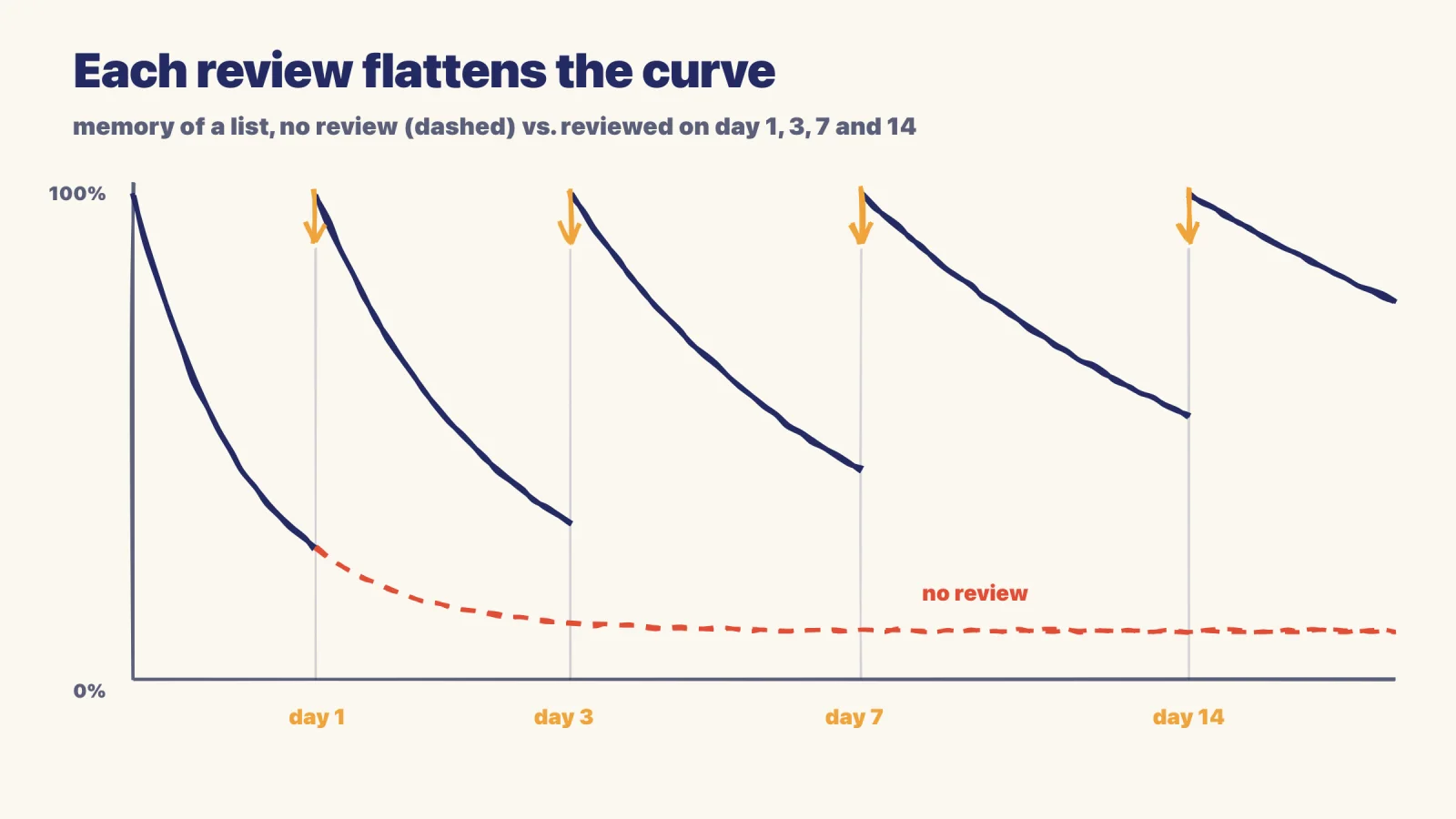
A practical spacing schedule (the exact gaps matter less than the fact that they grow):
- First review: 1 day after initial learning
- Second review: 3 days after first review
- Third review: 7 days after second review
- Fourth review: 14 days after third review
- Fifth review: 30 days after fourth review
- Sixth review: 60 days after fifth review
Each review should occur just as you're about to forget—not so soon that it's still fresh (waste of time) and not so late that you've already forgotten (you're relearning from scratch). Apps like Laxu AI, Anki and Quizlet automate the timing.

If you review on paper, pick the day you learned something and the planner gives you the five dates.
Your review dates
Pick the day you first learn something. The gaps grow because each successful recall buys you a longer one.
- Review 1 · 1 day laterThu, Oct 15
- Review 2 · 3 days laterSat, Oct 17
- Review 3 · 1 week laterWed, Oct 21
- Review 4 · 2 weeks laterWed, Oct 28
- Review 5 · 1 month laterFri, Nov 13
The spacing effect is one of the most replicated findings in learning research: Cepeda and colleagues (2006) reviewed 184 articles and found spaced practice beat massed practice for almost every kind of material and learner. You study the same amount and remember more—but only if you stick to the schedule.
Chunking: Expand your working memory capacity
Your working memory (the mental workspace where you temporarily hold information) can handle only about four "chunks" at once, according to Nelson Cowan's review of the evidence (2001). This limitation explains why remembering a 12-digit phone number feels impossible.
But here's the trick: you define what counts as a "chunk." A 12-digit number as individual digits (1-8-4-7-2-9-5-6-3-0-1-2) is 12 chunks—overload. Grouped as three 4-digit numbers (1847-2956-3012) is just 3 chunks—manageable.
Practical applications:
- For numbers: Use natural groupings (phone numbers, dates, patterns). To remember 1492, think "Columbus discovered America in 1492" if you know that context.
- For lists: Group related items. Instead of memorizing 15 random words, organize them: 5 animals, 5 colors, 5 tools.
- For concepts: Create hierarchical structures. Instead of memorizing 20 symptoms, organize under 5 body systems with 4 symptoms each.
- For procedures: Break into phases. A 15-step lab protocol becomes: Phase 1 (preparation, 4 steps), Phase 2 (execution, 7 steps), Phase 3 (cleanup, 4 steps).
- For foreign languages: Learn phrases, not isolated words. "How are you?" is one chunk; three separate words is three chunks.
Expert chess players can memorize entire board positions because they chunk patterns they've seen before. You can't expand working memory capacity, but you can make each slot hold more information through intelligent chunking.
Create associations: Hook new knowledge to old
New information sticks better when connected to what you already know. Your brain is a network of associations—memories rarely exist in isolation. Creating deliberate connections between new material and existing knowledge dramatically improves encoding.
Connecting new material to what you already know is called elaboration, and asking yourself why a fact is true (elaborative interrogation) is one of the techniques Dunlosky and colleagues (2013) rated as useful across a wide range of material. When you say "This is like X that I already know," you give the new fact a route back into memory.
Association techniques that work:
- Elaborative interrogation: Ask "why?" and "how?" about facts. Instead of memorizing "Mitochondria produce ATP," ask "How does the structure of mitochondria enable ATP production?" The explanation creates associations that pure facts lack.
- Visual imagery: Convert abstract concepts into vivid mental images. To remember that "insulin lowers blood sugar," picture insulin as a key unlocking cells to let sugar in. Bizarre, exaggerated, or emotional images stick better than realistic ones.
- Personal connections: Relate new material to your life. Learning about the French Revolution? Connect it to a power struggle you witnessed at work or school. Personal relevance boosts retention.
- Mnemonics: Create memorable phrases or acronyms. "Every Good Boy Does Fine" for musical notes (E-G-B-D-F) or "Please Excuse My Dear Aunt Sally" for order of operations (Parentheses, Exponents, Multiplication, Division, Addition, Subtraction).
- Storytelling: String unrelated facts into a narrative. To memorize a shopping list (eggs, bread, milk, apples), imagine a story: "A giant egg cracked open, and bread rolled out. The bread was drowning in milk, and apples fell from a tree above." Absurd stories are more memorable than logical ones.
- Analogies: "The cell membrane is like a security guard—it controls what enters and leaves." Analogies tap into deep understanding of familiar concepts to explain new ones.
The method of loci: Ancient memory palace technique
Also called the "memory palace" technique, this method has been used since ancient Greece. Cicero used it to memorize hours-long speeches without notes. Modern memory champions use it to memorize thousands of random digits.
The technique exploits your brain's exceptional ability to remember spatial information. You can easily recall the layout of your childhood home, right? The method of loci piggybacks new information onto that spatial memory.
Step-by-step implementation:
- Choose a familiar location: Your house, commute route, school hallway—anywhere you know intimately.
- Define a specific path: Front door → living room → kitchen → bedroom. The path should be logical and consistent.
- Place information along the path: At each location, create a vivid image of what you're memorizing. To remember the order of U.S. presidents, place Washington standing at your front door, Adams sitting in your living room, Jefferson cooking in your kitchen.
- Make images bizarre and vivid: Exaggeration, absurdity, and emotion enhance memory. Don't picture a small, normal apple—picture a giant, neon-green apple that's singing.
- Walk the path mentally: When you need to recall, mentally walk through your location and "see" what you placed there.
Dresler and colleagues (2017) scanned the brains of memory athletes and found nothing unusual in their anatomy. After six weeks of memory-palace training, ordinary participants roughly doubled the number of words they could recall from a list, and their brain connectivity started to resemble the athletes'.
Best uses: Ordered lists, speeches, sequential procedures, historical timelines, or any information with a natural sequence. Less effective for concepts requiring deep understanding rather than pure recall.
Sleep and memory: Your brain's maintenance window
Sleep isn't just rest—it's when your brain consolidates memories. During deep sleep and REM sleep, your hippocampus (temporary storage) replays the day's information, transferring it to the neocortex (permanent storage). Without adequate sleep, this transfer doesn't happen effectively.
Decades of experiments reviewed by Rasch and Born (2013) show that people who sleep after learning retain more than people who stay awake for the same period. The difference isn't just alertness—it's consolidation.
How sleep specifically helps memory:
- Consolidation: Converting short-term memories into long-term storage happens primarily during sleep.
- Integration: Your brain connects new information with existing knowledge, creating the associations discussed earlier.
- Pruning: Less important information is weakened, strengthening important memories through contrast.
- Preparation: Clearing out the "cache" of working memory so you're ready to learn new information tomorrow.
Practical applications:
- Study before bed: Information reviewed in the hour before sleep gets prioritized for consolidation. Make flashcard review your final activity.
- Get 7-9 hours nightly: Chronic sleep deprivation impairs memory formation. You can't compensate with extra study time; a tired brain encodes less of what you study.
- Avoid all-nighters: Staying up all night to cram may help you pass tomorrow's test (maybe), but you'll forget everything within days. The information never gets consolidated properly.
- Power naps work: A 20-minute nap can enhance memory consolidation for recently learned material. Longer naps (60-90 minutes) that include REM sleep show even stronger effects.
- Maintain consistent sleep schedule: Going to bed and waking at consistent times optimizes your sleep architecture for memory consolidation.
The same review notes that sleep deprivation also impairs the ability to form new memories, not just to consolidate existing ones. A sleep-deprived brain encodes less during study sessions, so some of that time is wasted.
Interleaving: Mix it up for better retention
Blocked practice (studying one topic until mastery, then moving to the next) feels more productive than interleaved practice (mixing multiple topics in one session). But research consistently shows interleaving produces better long-term retention and transfer.
Why? Interleaving forces your brain to actively discriminate between concepts and repeatedly reload information, strengthening retrieval pathways. When you study Topic A for an hour, your brain stays in "Topic A mode." When you switch between A, B, and C every 20 minutes, your brain must work harder to reactivate the appropriate knowledge each time.
Example: Instead of doing 30 algebra problems, then 30 geometry problems, then 30 trigonometry problems, do 10 algebra, 10 geometry, 10 trigonometry, repeat. It feels harder and less productive, but test performance is significantly higher.
Dual coding: Combine words and visuals
Your brain processes verbal and visual information through different pathways. When you encode information both verbally and visually, you create two separate memory traces, doubling your chances of successful retrieval.
Allan Paivio's dual coding theory (1991) holds that information stored both as words and as an image has two routes back into memory, which is one reason concrete, picturable concepts are easier to remember than abstract ones. The solution? Create visual representations even for abstract concepts.
Implementation:
- Draw diagrams, flowcharts, or mind maps for concepts
- Add simple images to flashcards alongside text
- Use color coding systematically (not just for aesthetics)
- Convert processes into visual timelines or flowcharts
- Create mental images of abstract concepts using metaphors
Practical daily routine for maximum retention
Here's how to integrate these techniques into a sustainable daily study schedule:
- Morning (20-30 min): Review flashcards from previous days. Use spaced repetition system (Anki automatically schedules reviews). This activates prior knowledge, priming your brain for new learning and preventing forgetting.
- Primary study session (90-120 min): Learn new material using active learning techniques. Don't passively read—read a section, close the book, summarize aloud or in writing. Create associations with existing knowledge. Chunk information into manageable groups. Take 10-minute breaks every 50-90 minutes (Pomodoro technique or ultradian rhythm approach).
- After studying (15-20 min): Immediately create flashcards for key concepts from what you just learned. This forces you to identify core ideas and creates your first retrieval practice. Include both verbal information and simple visual elements when possible.
- Afternoon practice (30-60 min): Do practice problems, questions, or other application exercises. This tests retrieval and identifies gaps. Interleave topics rather than blocking by subject. Struggle is productive—it signals your brain to strengthen these pathways.
- Evening review (20-30 min): Review flashcards created today plus any that are due from your spaced repetition schedule. This pre-sleep review gets prioritized for overnight consolidation. Keep it light—you're refreshing, not cramming.
- Before bed: Get 7-9 hours of sleep. Set a consistent bedtime. Avoid screens for 30-60 minutes before sleep (blue light disrupts sleep architecture). During sleep, your brain consolidates everything you learned today.
Weekly additions:
- One practice test per subject per week to assess retention
- One study group session to teach others (teaching forces elaboration)
- One review session of material from 2-4 weeks ago (extending spaced repetition)
Common mistakes that sabotage memorization
- Rereading as primary strategy: Reading something 5 times feels productive but produces minimal learning. Read once carefully, then switch to retrieval practice.
- Highlighting without processing: Highlighting feels active but requires no deep processing. Test yourself on highlighted material instead.
- Cramming everything at once: All-night study sessions create temporary memories that evaporate quickly. Distributed practice over time works better with less total study time.
- Studying the same topic all day: Blocked practice feels easier but produces inferior learning. Interleave topics even though it feels harder.
- Not testing yourself until exam day: Practice tests aren't just assessment tools—they're learning tools. Test yourself continuously throughout studying, not just at the end.
- Skipping sleep to study more: The trade-off is never worth it. One hour of sleep provides more memory consolidation than one additional hour of study.
- Passive learning: Watching videos or attending lectures without active engagement produces weak memories. Always pair passive input with active processing.
The bottom line
The goal isn't to memorize everything at once. It's to encode well and review strategically. Fast memorization comes from understanding how memory works and exploiting its principles: retrieval practice strengthens memories, spaced repetition prevents forgetting, chunking expands capacity, associations create access pathways, and sleep consolidates everything.
The techniques described here aren't tricks or shortcuts—they're applications of cognitive science. Students who use evidence-based learning strategies consistently outperform those who study longer using ineffective methods. Intelligence sets your ceiling, but strategy determines whether you reach it.
Start with active recall and spaced repetition—these two techniques do most of the work. Add chunking, associations, and adequate sleep, and you've built a memorization system that works with your brain's natural learning mechanisms rather than against them. The result: you memorize faster, retain longer, and study less. That's not magic—it's science.
Frequently Asked Questions
How many times do you need to review something to remember it?
Is it better to study before sleep?
Does rereading help you memorize?
What is the fastest way to memorize information for an exam?
Why is sleep important for memorization?
How can I remember information for years instead of just for exams?
Related articles
Continue learning with these related posts.


Put these techniques into practice
Upload your study materials and let Laxu AI create flashcards, notes, and quizzes automatically.