The Science of Memory: Why We Forget and How to Remember More

Your brain forgets most of what you learn within 24 hours. This isn't a flaw—it's a feature. Understanding why helps you work with your memory instead of against it.
Key takeaways
- Forgetting is your brain filtering out what seems unimportant
- Retrieval practice strengthens memories more than re-reading
- Sleep consolidates memories—studying before bed works
- Emotional connection and context improve retention dramatically
Why your brain forgets (and why that's actually useful)
In 1885, German psychologist Hermann Ebbinghaus conducted experiments on himself to measure memory decay. His findings, now called the "forgetting curve," showed that we lose roughly 70% of new information within 24 hours if we don't actively work to retain it.
This seems like a design flaw until you consider the alternative. Your brain processes millions of sensory inputs daily. If you remembered everything—every face on the subway, every word in every conversation, every item on every shelf—you'd be overwhelmed. Forgetting is your brain's way of prioritizing what matters.
The key insight: your brain decides what's important based on repetition, emotion, and usefulness. If you encounter something once and never again, your brain assumes it wasn't important. If you keep encountering it, especially in varied contexts, your brain strengthens that memory.
How memories are formed and stored
Memory formation happens in three stages: encoding, consolidation, and retrieval. Understanding each stage reveals why certain study methods work better than others.
Encoding is the initial learning moment. Your brain creates neural connections representing the new information. The strength of encoding depends on attention, meaning, and connection to existing knowledge. This is why distracted studying produces weak memories.
Consolidation happens primarily during sleep. Your hippocampus replays new memories, transferring them to long-term storage in the cortex. A 2014 study in Science showed that students who slept after learning retained 40% more than those who stayed awake. Your brain literally needs downtime to process what you learned.
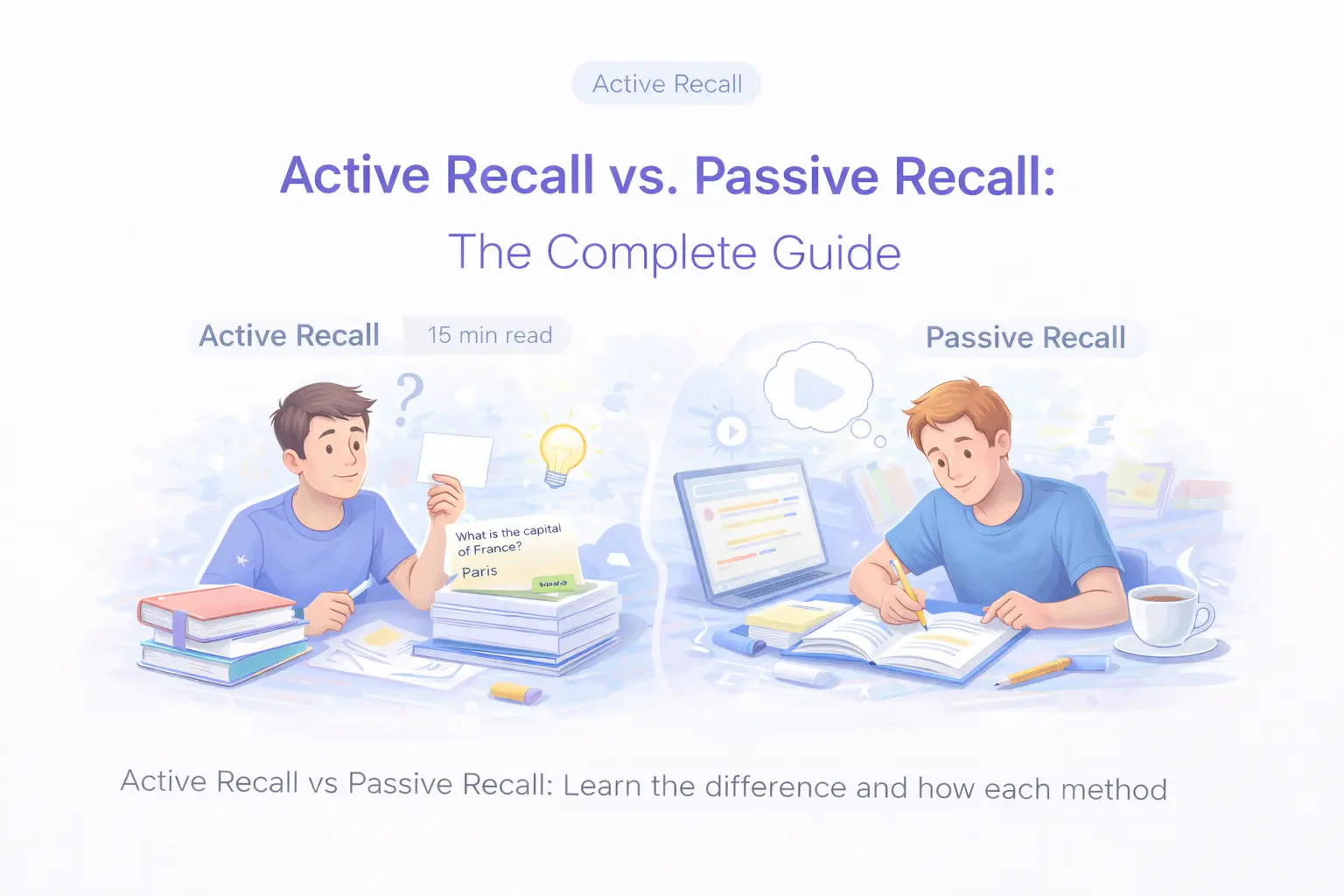
Retrieval is the act of accessing stored memories. Here's the counterintuitive part: every time you successfully retrieve a memory, you strengthen it. This is why testing yourself beats re-reading. The effort of pulling information from memory creates stronger neural pathways than passively reviewing it.
The testing effect: why retrieval beats review
A landmark 2006 study by Roediger and Karpicke demonstrated what researchers call the "testing effect." Students who took practice tests remembered 80% of material a week later, compared to just 36% for students who only re-read the content.
The mechanism is straightforward: when you try to recall something, you're exercising the exact neural pathway you'll need during an exam. Re-reading, by contrast, creates an illusion of fluency. The material feels familiar, but familiarity isn't the same as being able to produce an answer from scratch.
Practical application: convert your notes into questions. Instead of reading "Mitochondria produce ATP through cellular respiration," turn it into a flashcard: "What organelle produces ATP?" The act of generating the answer—even if you struggle—does more for retention than ten re-reads.
Spacing: the most powerful study technique most students ignore
Cramming works for tomorrow's test. Spacing works for long-term knowledge. The difference is dramatic.
When you space study sessions over days or weeks, you force your brain to reconstruct the memory each time. That reconstruction effort strengthens the memory. When you cram, you're essentially loading information into short-term memory without giving it time to consolidate.
A practical spacing schedule: study material on day 1, review on day 3, again on day 7, and finally on day 14. Each review session can be short—15 to 20 minutes. This distributed approach produces significantly better long-term retention than a single 2-hour session.
Tools like Laxu AI automate this process. When you create flashcards, the system schedules reviews based on your performance, showing difficult cards more frequently and easy cards less often.
The role of sleep in memory consolidation
Sleep isn't just rest—it's when your brain does its heaviest memory work. During slow-wave sleep, your hippocampus replays the day's experiences, strengthening neural connections for important information and pruning irrelevant details.
Research from the University of Lübeck found that students who slept between learning and testing outperformed those who stayed awake by 44%. The effect was especially strong for complex material requiring integration of multiple concepts.
Practical implications: study your hardest material in the evening, then sleep on it. Avoid all-nighters before exams—the sleep deprivation undermines consolidation and impairs retrieval. A well-rested brain recalling 80% beats an exhausted brain that crammed but can only access 50%.
Emotion and meaning: the memory amplifiers
You remember your first day of college better than your fourth Tuesday of sophomore year. Emotion acts as a signal to your brain: this matters, store it carefully.
The amygdala, your brain's emotional processing center, modulates memory encoding. When something triggers an emotional response—curiosity, surprise, even frustration—the amygdala signals the hippocampus to pay attention. This is why stories are more memorable than lists, and why finding personal relevance in material helps you remember it.
You can hack this by creating meaning deliberately. Instead of memorizing that insulin regulates blood sugar, understand why: without insulin, glucose builds up in blood, damaging organs. Connect facts to consequences, mechanisms to real-world impacts. The emotional weight of understanding makes memories stickier.
Interleaving: mix topics for better transfer
Blocked practice—studying one topic exhaustively before moving to the next—feels productive but produces narrow learning. Interleaving, or mixing different topics within a study session, feels harder but creates more flexible knowledge.
A study published in Applied Cognitive Psychology found that students who interleaved practice problems scored 43% higher on transfer tests than those who practiced in blocks. The interleaved group was better at recognizing which technique to apply to novel problems.
In practice: don't spend an hour only on calculus derivatives. Mix in some integral problems. When studying history, jump between time periods. This forced context-switching requires your brain to continually retrieve the relevant framework, strengthening those retrieval paths.
Building a memory-friendly study routine
Combine these principles into a sustainable system:
- Morning: Review yesterday's material with flashcards (15-20 min). The overnight consolidation means you're testing what actually stuck.
- Study sessions: Focus for 25-50 minutes, then take a 5-10 minute break. During breaks, avoid screens—let your brain process.
- Active recall: After reading a section, close your notes and write down what you remember. Check for gaps.
- Evening: Brief review of the day's hardest material before bed. Sleep will consolidate it.
- Weekly: Interleave topics in a longer review session. Quiz yourself on material from two weeks ago.
Why AI-generated flashcards accelerate learning
The bottleneck in flashcard-based learning has always been card creation. Writing good flashcards takes time—time you could spend actually studying.
AI tools like Laxu AI solve this by generating cards from your notes, PDFs, or lecture slides. The cards follow best practices automatically: one concept per card, clear prompts, concise answers. You can review and edit them, but the heavy lifting is done.
This shifts your time from creation to retrieval practice—exactly where the learning happens. Upload a 30-page PDF and have 100 study-ready flashcards in minutes. Then spend your time actually using them.
Conclusion: work with your brain, not against it
Your brain isn't broken because it forgets. It's optimized for filtering. When you understand this, study techniques stop being arbitrary rules and become logical strategies:
- Test yourself because retrieval builds stronger memories than review
- Space your study because reconstruction strengthens retention
- Sleep because consolidation requires downtime
- Find meaning because emotion amplifies memory
- Interleave because flexibility requires varied practice
Memory isn't a gift you either have or don't. It's a skill you can systematically improve by aligning your study habits with how your brain actually works.
Frequently Asked Questions
Why do I forget what I studied so quickly?
Is testing yourself really better than re-reading notes?
How does sleep affect memory and studying?
Related articles
Continue learning with these related posts.

Put these techniques into practice
Upload your study materials and let Laxu AI create flashcards, notes, and quizzes automatically.