Law School Study Tips: Flashcards for Cases and Rules
Law school requires mastering legal rules and applying them to new fact patterns. Flashcards help with the first part so you can focus on analysis.
Key takeaways
- Create cards for rules, not entire cases
- Use issue-spotting practice alongside flashcards
- Start bar prep cards early
Why law school is different
Law school exams test two distinct skills: rule knowledge and legal analysis. You need to know what the rule is before you can apply it to novel fact patterns. Research shows that students who can quickly recall legal rules perform 30-40% better on issue-spotting exams because they spend more mental energy on application rather than searching their memory.
Flashcards are the most efficient tool for building automatic rule recall. They force active retrieval—the same mental process you'll use during exams. But flashcards alone aren't enough. They're the foundation that supports higher-level analytical skills.
What to put on flashcards
Don't memorize entire case briefs. Extract the legal rule or principle. "What is the rule from Palsgraf v. Long Island Railroad?" Answer: "Duty is owed only to foreseeable plaintiffs within the zone of danger."
Focus on distilling cases to their essential holdings. Most 1L mistakes come from putting too much information on cards—full fact patterns, procedural history, dicta. Your flashcard should contain only what you'd cite in an exam answer: the rule statement and any essential elements or factors.
For landmark cases, include both the case name and the rule. Professors expect you to cite Pennoyer, International Shoe, and other foundational cases by name. For less prominent cases, focus on the rule itself rather than memorizing which case it came from.
Card formats that work
- Rule cards: Legal rule + elements/factors
- Definition cards: Legal term + precise definition
- Test cards: "What test applies to X?" + answer
- Exception cards: Rule + exceptions
Step-by-step card creation process
After reading and briefing a case, follow this workflow:
- Identify the holding: What legal principle did the court establish?
- Write the rule statement: Strip away facts and extract the general principle
- Note any elements or factors: If the rule has a multi-part test, list each element
- Add exceptions if applicable: Many rules have important exceptions or limitations
- Include the policy rationale: Understanding why helps with application and retention
Example card for Contracts: Front: "What is the mailbox rule?" Back: "Acceptance is effective when dispatched (placed in the mail), not when received. Exception: If offer specifies acceptance must be received, or if rejection is sent first."
Creating cards from casebooks
After briefing a case, identify the holding and any rule statement. Create a card for that rule. Include the case name if it's a landmark case professors expect you to cite.
Don't create cards during class. You need to focus on understanding, not transcribing. Instead, set aside 15-20 minutes after each class to review your brief and create 5-10 cards from the most important rules. This post-class processing significantly improves retention.
Use your professor's language when possible. If they emphasize a particular phrasing of a rule or test, use that exact wording on your flashcard. Law school exams reward precision, and using the professor's terminology shows you've understood their approach to the material.
Subjects that benefit most
- Civil Procedure: Rules, standards of review, jurisdictional tests
- Evidence: Hearsay exceptions, privilege rules
- Constitutional Law: Standards of review, doctrine names
- Contracts: UCC vs. common law rules
Civil Procedure and Evidence benefit the most from flashcards because they involve numerous discrete rules and exceptions. Constitutional Law works well for memorizing standards of review and doctrine names. Torts and Contracts have fewer rules but benefit from cards that distinguish similar concepts.
Property requires a different approach—focus on rule statements for estates, concurrent ownership, and recording acts. Criminal Law flashcards should emphasize elements of crimes and defenses. For upper-level courses, adapt your approach based on whether the course is rule-heavy (Tax, Commercial Law) or more conceptual (Jurisprudence).
Balancing flashcards with practice
Flashcards teach rules. Practice exams teach application. Use flashcards to build your foundation, then spend most of your time doing practice questions and essay writing.
A good study plan allocates time as follows: During the semester, spend 20% of study time on flashcards, 30% on reading and briefing, and 50% on practice problems and hypotheticals. In the three weeks before finals, shift to 10% flashcards, 10% review, and 80% practice exams under timed conditions.
The biggest mistake 1Ls make is spending too much time making and reviewing flashcards at the expense of practice. Flashcards should feel almost automatic—if you're still struggling to recall basic rules two weeks before the exam, you started too late or you're not reviewing consistently.
Review schedule for law school
Use spaced repetition to maximize retention. Review new cards daily for the first week, then every three days, then weekly. Most students find that 15 minutes of flashcard review per subject per day is sufficient during the semester. Increase to 30 minutes per subject during finals preparation.
Front-load your card creation and initial review. If you wait until reading period to start flashcards, you won't have time to build long-term retention. Students who begin flashcards in week 2 of the semester and review consistently throughout perform significantly better than those who cram flashcards during finals.
Bar exam prep
Start creating bar-focused cards in 2L. The MBE tests specific rules that can be memorized. Supplement commercial bar prep with your own cards for rules you find difficult.
Bar prep is different from law school exams. The MBE tests narrow rule statements across multiple jurisdictions. You need cards for majority rules, minority rules, and common exceptions. Many successful bar-takers report having 2,000-3,000 cards by bar exam time.
Don't rely solely on commercial bar prep flashcards. Their cards are designed for the average student. Create your own cards for rules you personally find confusing. If you consistently miss questions about hearsay exceptions or future interests, make targeted cards for those specific topics.
For the MEE and state essays, your law school flashcards remain useful. Keep and review cards from your 1L courses—many MEE topics directly test Contracts, Torts, Civil Procedure, and Evidence at a level similar to law school exams.
Common mistakes to avoid
- Creating cards that are too detailed: If your answer takes more than 30 seconds to recite, the card is too complex. Split it into multiple cards.
- Memorizing without understanding: Always include the policy rationale in your learning, even if it's not on the card itself. Understanding why helps you apply rules correctly.
- Skipping practice exams: No amount of flashcard review substitutes for writing practice essays under timed conditions.
- Making cards for everything: Be selective. Not every case needs a flashcard. Focus on rules your professor emphasizes and rules that appear repeatedly.
- Never reviewing cards: Creating cards without reviewing them is wasted effort. Commit to daily review sessions.
- Using someone else's cards exclusively: Creating cards yourself forces you to process and understand the material. Use others' cards for comparison, not replacement.
Digital vs. paper flashcards
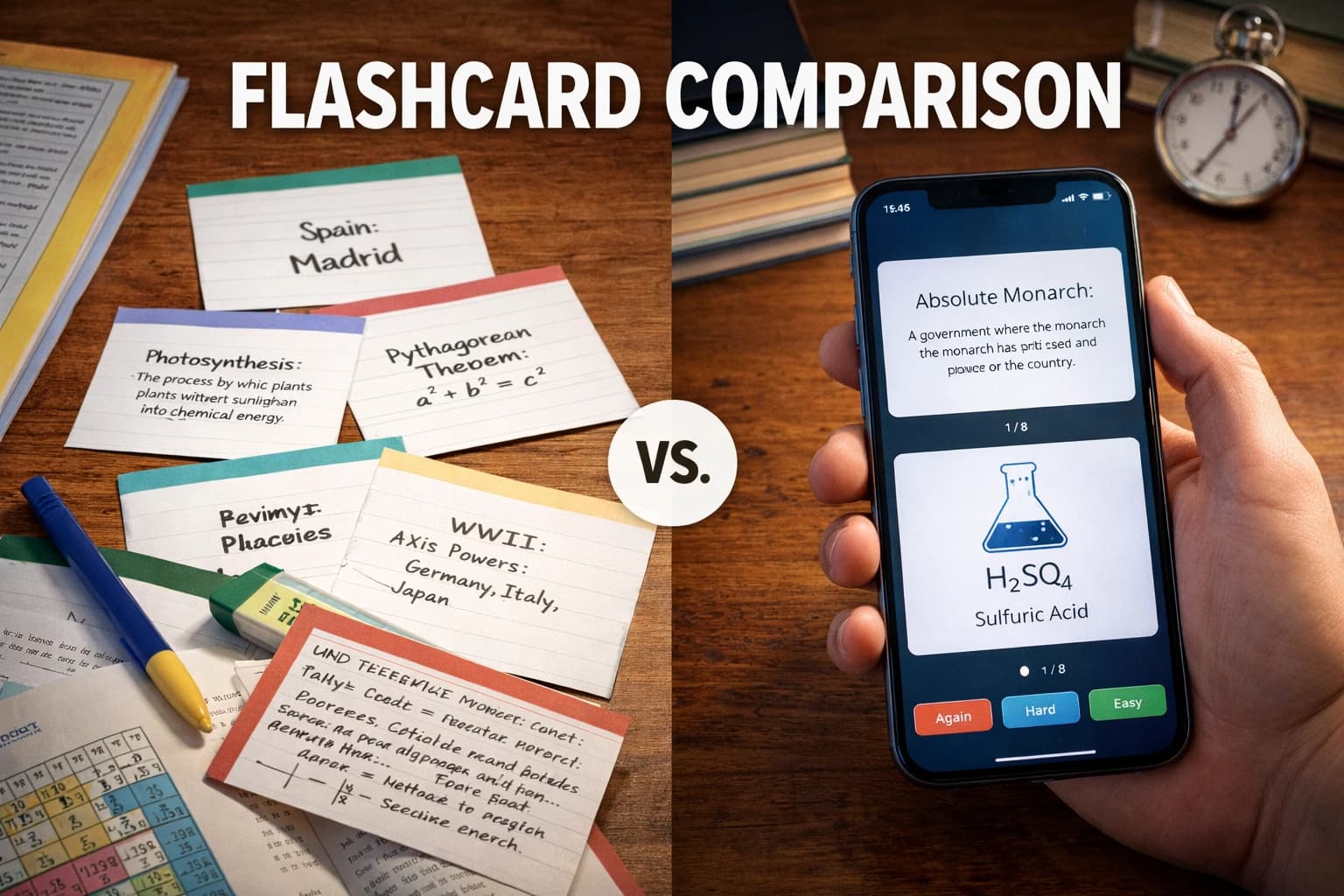
Digital flashcard apps like Anki or Laxu AI offer spaced repetition algorithms that automatically schedule reviews. They're particularly useful for law school because you'll accumulate hundreds of cards across multiple subjects. Digital cards are searchable, editable, and accessible from any device.
Some students prefer paper flashcards for kinesthetic learning. Writing cards by hand can improve retention, though it's more time-consuming. A hybrid approach works well: handwrite cards initially, then transfer important ones to a digital system for long-term review.
Sample law school flashcard deck structure
Organize your cards by subject, then by topic within each subject. For example, in Civil Procedure: Personal Jurisdiction, Subject Matter Jurisdiction, Pleadings, Discovery, Summary Judgment, Trial, Appeals. Tag cards with case names so you can review cards related to specific cases if needed.
Create "connecting" cards that ask about relationships between rules. For example: "What's the difference between issue preclusion and claim preclusion?" These cards test deeper understanding and help with analysis-heavy questions.
The goal is quick recall of rules so you can spend exam time on analysis, not remembering what the rule is. Flashcards are a tool, not the entire strategy. Use them to build a foundation of automatic rule knowledge, then focus your energy where it matters most: applying those rules to complex, ambiguous fact patterns.
Frequently Asked Questions
How should law students use flashcards?
When should I start making flashcards for law school?
Should I use flashcards for bar exam prep?
Related articles
Continue learning with these related posts.


Put these techniques into practice
Upload your study materials and let Laxu AI create flashcards, notes, and quizzes automatically.