
Finals success comes from strategic review, not last-minute cramming. Here's a structured approach for the weeks before exams.
Key takeaways
- Start 3-4 weeks before finals
- Create a master list of all topics
- Practice under exam conditions
4 weeks out: Inventory and plan
This is assessment week. Your goal is comprehensive inventory, not deep study yet.
Create your master topic list: For each class, list every major topic from the syllabus, lecture slides, and table of contents. A typical semester course has 25-40 distinct topics. Use a spreadsheet or document where you can check off progress.
Honest self-assessment: Mark each topic with a color code or rating:
- Green/5: I could teach this to someone else
- Yellow/3: I recognize it and remember some details, needs review
- Red/1: Completely lost, need to learn from scratch
Most students overestimate how much they know until they test themselves. That is also why the assessment has to be a test and not a read-through: in Roediger and Karpicke's experiments (2006), students who reread felt more confident than students who self-tested, and remembered less a week later.
Calculate your time budget: Count your available study hours over the next 4 weeks. Be realistic—factor in classes, work, sleep, and life obligations. Allocate time proportionally: red topics get 50% of your time, yellow topics get 35%, green topics get 15%.
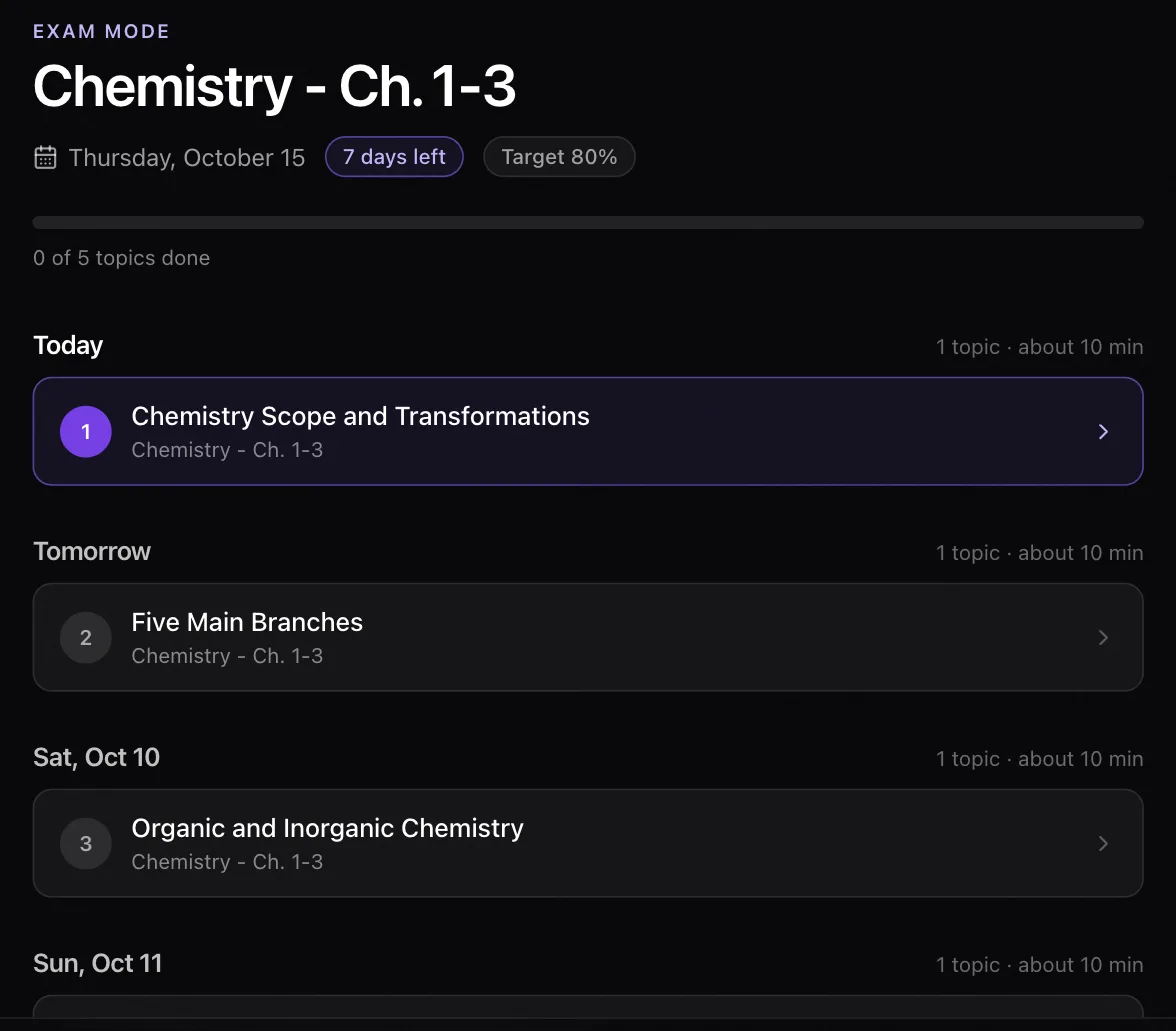
Begin flashcard creation: As you review notes for your inventory, create flashcards for key concepts. Focus on definitions, formulas, processes, and anything requiring precise recall. Aim for 20-30 cards per subject this week. Don't try to be comprehensive yet—just capture the obvious high-value content. If you let Laxu AI make the first pass from the lecture PDF, expect about 39 cards per upload (the median across 907 PDF and Word uploads in the 30 days to 9 October 2026), then delete the ones you already know cold.
Gather all materials: Find syllabi, old assignments, graded exams, practice problems, textbooks. Everything you'll need for the next 4 weeks should be organized and accessible. Lost time searching for materials is wasted study time.
3 weeks out: Fill gaps
This is your learning week. Focus exclusively on weak areas—the red topics that you never understood.
Attack your red topics first: These need the most processing time. Allocate 60-90 minute blocks for each major gap. Start with textbook reading, move to worked examples, finish with practice problems. The progression from passive to active is crucial.
Use multiple resources: If the textbook didn't work the first time, it probably won't work now. Try supplemental videos (Khan Academy, Crash Course, YouTube channels specific to your subject), different textbooks from the library, study guides, or peer tutoring. Sometimes one explanation clicks where another didn't.
Create comprehensive flashcards: Add 30-40 new cards per subject this week. Focus on your weak areas—these need the most repetition cycles. Each card should test one discrete piece of knowledge with a clear question and complete answer.
Attend review sessions: Professors and TAs often hold optional review sessions starting 3 weeks out. Go to all of them. Even if they cover material you know, you'll hear what the instructor emphasizes—strong signals for exam focus.
Form a study group: Meet 2-3 times this week with 2-4 other serious students. Teach your strong topics to others; let them teach you their strong topics. Research shows that teaching material to others is one of the most effective learning strategies, because explaining forces you to retrieve and reorganise the material instead of re-reading it. (If you have seen a "90% retention" figure attached to teaching, it comes from the learning pyramid, which has no experimental source behind it.)
Don't neglect yellow topics: Spend 20-30% of your time doing light review of material you partially know. Often, "kind of understanding" something leaves dangerous gaps that cost points on exams.
2 weeks out: Active practice
This is your application week. Stop passively absorbing information and start actively using it.
Shift to practice-based study: Your study time should now be 70% active practice (problems, questions, flashcards) and only 30% passive review (reading notes, watching videos).
Do all available practice exams: Old exams, practice exams from textbooks, online question banks—do them all under realistic conditions. Timed, no notes, no phone. Treat each like the real exam. Practice testing is one of only two techniques that Dunlosky and colleagues (2013) rated "high utility" after reviewing the evidence on ten common study methods; the other is spacing your study out.
Review flashcards daily: You should have 100-200 cards per subject by now. Use spaced repetition: review all cards daily, but spend extra time on cards you miss consistently. A solid flashcard review session should take 30-45 minutes per subject.
Analyze your mistakes: After each practice exam, spend twice as long reviewing wrong answers as you spent taking the exam. Don't just look up the right answer—understand why you got it wrong. Was it a content gap? Misreading the question? Calculation error? Each error type needs a different fix.
Simulate exam conditions regularly: Take at least one full-length practice exam per subject this week under exact exam conditions: same time of day, same environment, same rules. This reduces test-day anxiety and builds stamina. Many students know the material but struggle with the mental endurance needed for 2-3 hour exams.
Create summary sheets: Condense each topic to one page of key formulas, concepts, and relationships. This forces you to identify what's truly essential. These become your final review materials for the last 48 hours.
1 week out: Consolidate
This is your refinement week. No new learning—only strengthening what you already know.
Final flashcard push: Review all cards in all subjects. Sort them into "know cold" and "still shaky" piles. For the final week, focus 80% of your flashcard time on the shaky pile. Aim to get every card into the "know cold" category.
One last practice exam per subject: This is your final diagnostic. Take it seriously. If you score below your target, adjust your last-week focus to address remaining gaps. If you score at or above target, it's a confidence booster going into finals.
Organize your materials: Group everything by exam. Flashcards, summary sheets, practice problems, and notes for each subject should be together in one place. The night before each exam, you'll grab that subject's folder and do a quick review—no time wasted searching.
Focus on high-frequency topics: Review what appeared on midterms, what the professor emphasized repeatedly, what shows up in practice exams. Professors signal what they think is important. Listen to those signals.
Protect your routine: This is not the week to pull all-nighters or skip meals. Maintain regular sleep (7-8 hours), eat properly, exercise briefly (even 15-minute walks help). A well-maintained body supports a sharp mind.
Make your exam schedule: Map out when and where each exam is. Calculate how much review time you have between exams. Prioritize which exams need the most attention based on your current standing in each class and how much they count toward your final grade.
Day before: Light review only
This is your maintenance day, not your learning day. Trying to cram new information now is counterproductive.
Quick flashcard session: Review cards one final time, 20-30 minutes per subject. Focus on frequently-missed cards. This is refreshing your memory, not building new knowledge.
Glance at summary sheets: Read through your one-page summaries to refresh the big picture. Don't try to memorize new formulas or concepts. If you don't know it by now, one evening won't change that.
Do not learn anything new: Seriously. New information introduced the night before can interfere with established memories through a phenomenon called retroactive interference. Review what you know; leave gaps alone.
Prepare logistics: Pack your backpack with everything you need (ID, pencils, calculator, water bottle). Set multiple alarms. Check the exam location and parking situation. These mundane details handled tonight mean less stress tomorrow.
Get 7-8 hours of sleep: This is non-negotiable. Sleep is when the day's learning is consolidated into longer-term memory (Rasch and Born, 2013), so the hours you cut tonight come out of what you studied today.
Exam day tips
- Eat breakfast with protein: Even if you're not hungry, eat something. Your brain runs on glucose. Complex carbs plus protein (oatmeal with nuts, eggs with toast) provide steady energy. Avoid pure sugar which causes energy crashes.
- Arrive early to settle nerves: Get there 15-20 minutes early. Use restroom, find your seat, get comfortable. Rushing in at the last second elevates stress hormones that impair memory retrieval.
- Do a quick memory dump: When you get the exam, immediately write down formulas, mnemonics, or concepts you're worried about forgetting. This clears mental space and ensures you won't lose these under time pressure.
- Read all instructions carefully: Sounds obvious, but time pressure makes people skip instructions. Know point values, whether questions are weighted equally, if there's partial credit, and how much time you have.
- Start with questions you know: This builds confidence and banks easy points. Mark questions you're unsure about and return to them later. Spending 10 minutes stuck on one hard question early can cost you three easy questions you never reached.
- Leave time to review answers: Reserve the last 10-15% of exam time for review. Check calculations, reread essay responses, make sure you answered what was actually asked. Many points are lost to careless errors, not knowledge gaps.
- Manage time actively: Know your pace. For a 120-minute exam with 60 questions, that's 2 minutes per question. At minute 60, you should be at question 30. Adjust if you're behind.
Allocating study hours by exam difficulty and grade weight
My background is in corporate strategy — at the heart of it, that field is about allocating finite resources across competing claims. Finals is the same problem in miniature. You have a fixed number of study hours and four to six exams competing for them. The intuitive split — "equal time per exam" or "more time on the hard ones" — leaves a lot on the table because it doesn't account for what your hours actually earn you. Here is the framework I'd use:
The variables that matter. For each exam, write down three numbers:
- Grade weight — what percentage of your final grade is this exam worth? A final worth 40% of the class is fundamentally different from one worth 15%, even if both feel equally urgent.
- Current confidence — on a scale of 1 (no idea) to 5 (could ace it tomorrow), how prepared do you feel right now? Be honest. Self-deception here is the most expensive mistake students make at finals.
- Material difficulty — 1 (review-heavy course you've kept up with) to 5 (intro to a brand new topic where you're still struggling with fundamentals).
The formula. Multiply weight × (5 − confidence) × difficulty for each exam. That product is the exam's opportunity value — how much your study hours could actually move the needle. Now allocate your total available hours in proportion to those products.
A worked example. Suppose you have 30 hours of finals study time and four exams:
- Biology — 30% weight, confidence 3, difficulty 4 → 30 × 2 × 4 = 240
- History — 15% weight, confidence 4, difficulty 2 → 15 × 1 × 2 = 30
- Calculus — 25% weight, confidence 2, difficulty 5 → 25 × 3 × 5 = 375
- Psychology — 30% weight, confidence 4, difficulty 3 → 30 × 1 × 3 = 90
Total = 735. Hours allocated: Biology 30 × 240/735 ≈ 10 hours; History ≈ 1 hour; Calculus ≈ 15 hours; Psychology ≈ 4 hours.
Put your own exams in below and the split updates as you type.
Split your study hours
Weight is the share of your final grade. Confidence and difficulty run from 1 to 5. Hours follow weight × (5 − confidence) × difficulty.
| Exam | Weight % | Confidence | Difficulty | Hours |
|---|---|---|---|---|
| 10 | ||||
| 1 | ||||
| 15.5 | ||||
| 3.5 |
Nothing is saved or sent anywhere. Redo the confidence numbers after each study block.
Notice what this does: Calculus, where you're not ready and the stakes are high, gets half your total time. History, where you're already confident and the stakes are low, gets one hour. An equal-time split would have given each exam 7.5 hours — wasting hours on subjects where additional study had low marginal return and starving Calculus where it had the highest.
Recalibrate mid-week. After each major study block, redo the confidence number for that subject. If three hours of Calculus moved your confidence from 2 to 3.5, the formula now allocates fewer of the remaining hours to it. The reallocation happens automatically because you're following the math, not your gut — which usually wants to keep grinding on whatever you most recently felt anxious about, regardless of whether more time there is actually earning anything.
You don't need to be precise to the hour. The point of the framework is to force you to confront the tradeoffs explicitly — to put numbers on what you're actually choosing when you decide to study Biology instead of Calculus. Most students never do this calculation, then wonder why their final grades shifted unexpectedly in directions they could have predicted in advance.
Managing multiple exams
Once you have your hours allocated by the framework above, you still need to sequence them across the finals week. A few rules:
Front-load by exam order, not by total hours: Your exam schedule dictates the sequence, even if the formula says one subject deserves more total time. If Biology is Monday and Calculus is Friday, Monday-through-Sunday needs Biology focus first — even if Calculus deserves more of your total hours overall. You'll get back to Calculus after Biology is done.
Don't neglect later exams entirely: Even when front-loading the immediate exam, reserve at least one 60-90 minute block per day for the next exam in line. Otherwise you'll arrive at it cold and panicked. The bulk of Friday's exam prep happens Tuesday-Thursday, but a thin daily touch from Sunday onward keeps you in the material.
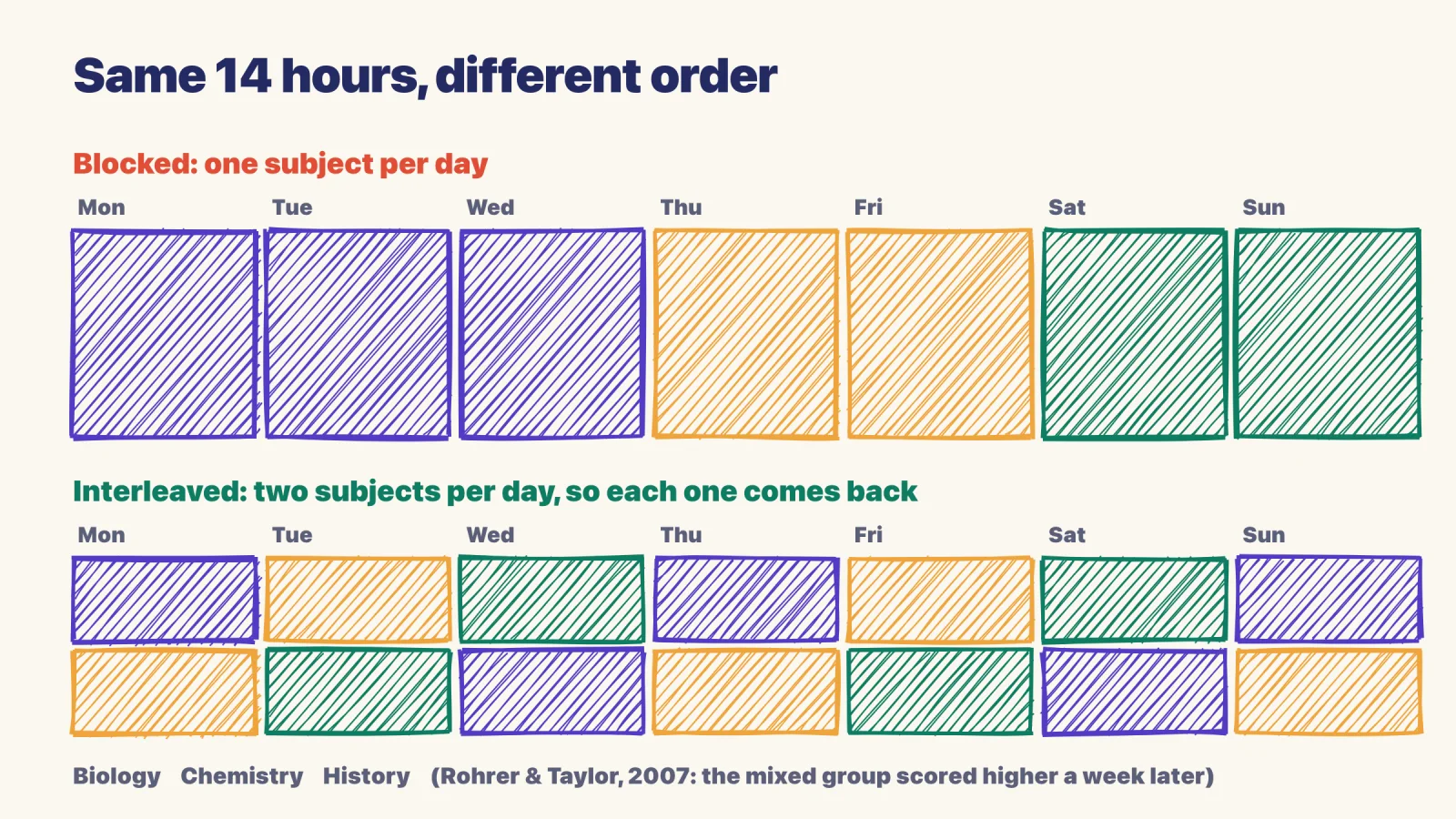
Alternate subjects to avoid burnout: Switching between subjects keeps your mind fresh. Two hours of history, then one hour of chemistry, then back to history works better than five straight hours of history. This is called interleaving: Rohrer and Taylor (2007) found students who mixed problem types during practice scored far higher on a test a week later than students who practised one type at a time, even though the mixed group felt worse during practice.
Use exam gaps strategically: If you have Monday and Thursday exams, Monday evening and Tuesday are prime study time for the Thursday exam. Don't waste this time celebrating exam one—immediately pivot to exam two.
Dead time is flashcard time: Commuting, waiting in line, eating alone—use these moments for flashcard review on your phone. Ten 5-minute review sessions throughout the day equals nearly an hour of studying, and the distributed practice is actually more effective than one 50-minute block.
When you're short on time
Didn't start early? Behind schedule? Here's the emergency protocol:
Focus ruthlessly on high-yield topics: What did the professor emphasize repeatedly? What appeared on midterms? What's in practice exams? Study these first and thoroughly. Better to know 60% of the material deeply than 100% of the material superficially.
Use the 80/20 rule: A minority of topics usually carries most of the marks. Identify that core and master it. You might have to accept not knowing everything.
Prioritize by point value: If the final is 40% of your grade and you're at a B, focus there. If it's 20% and you're at an A, you have more margin for error. Calculate what scores you need for your desired grades and allocate time accordingly.
Practice tests over notes: In a time crunch, doing practice problems and past exams beats reading notes. Active recall under pressure reveals what you actually know versus what you think you know.
Create bare-minimum flashcards: Just definitions, formulas, and key concepts. Skip the nice-to-know details. Thirty high-quality flashcards reviewed ten times beats 200 flashcards reviewed once.
Ask for help strategically: Use office hours for your biggest confusion points. Professors can often clarify in 10 minutes what would take you two hours to piece together from the textbook.
Common mistakes to avoid
- Starting too late: The single biggest mistake. Four weeks is minimum; six weeks is better for cumulative finals.
- Passive review instead of active practice: Rereading notes feels productive but produces minimal learning. Testing yourself is harder but far more effective.
- Studying the same easy topics repeatedly: We gravitate toward what we already know because it feels good. Force yourself to tackle weak areas.
- All-nighters: They destroy memory consolidation. One good night of sleep is worth more than four extra hours of studying.
- Skipping practice exams: They're the single best predictor of actual exam performance and the best diagnostic of remaining gaps.
- Neglecting self-care: Sleep, nutrition, and exercise aren't luxuries during finals—they're performance enhancers backed by extensive research.
The bottom line
Finals success comes from strategic, early preparation combined with active practice. The four-week plan works because it aligns with how memory formation actually happens—you need time for information to consolidate and strengthen through repeated retrieval. Students who start early, honestly assess their knowledge, focus on weak areas, and practice under exam conditions consistently outperform those with equal intelligence who cram. Intelligence determines your ceiling; strategy determines whether you reach it. Start now, stick to the plan, and trust the process.
Frequently Asked Questions
Should I study one subject per day or mix them?
How many hours a day should I study for finals?
What should I do the night before a final?
When should I start studying for finals?
How do I prioritize what to study for finals?
Should I pull an all-nighter before finals?
Related articles
Continue learning with these related posts.
Put these techniques into practice
Upload your study materials and let Laxu AI create flashcards, notes, and quizzes automatically.