
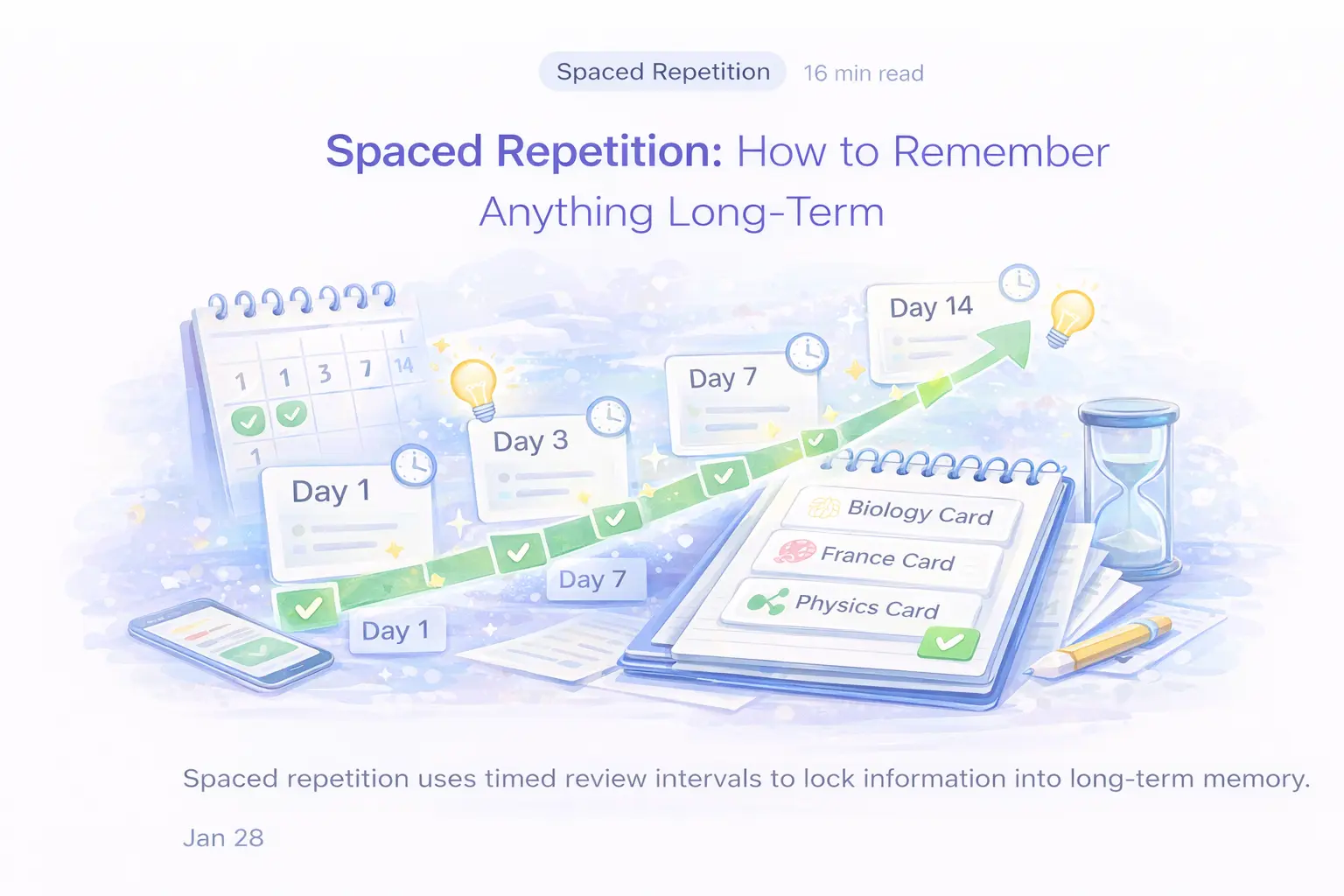
A study schedule works when it's realistic, flexible, and built around your actual life—not an idealized version of it.
Key takeaways
- Start with your fixed commitments, then add study blocks
- Include breaks and buffer time
- Review and adjust weekly
Why most study schedules fail
Research shows that 73% of students abandon their study schedules within two weeks. The problem isn't discipline—it's unrealistic planning. Students create schedules based on how they wish they could study (8 focused hours daily, perfect attendance, no distractions) rather than how they actually function.
The schedules that work are built backward: start with non-negotiable commitments, identify genuinely available time, then allocate study blocks based on energy levels and subject demands. This approach creates a schedule you can actually follow, not one that lives permanently on your wall while you study randomly.
Step 1: Audit your time
Before creating a schedule, track how you actually spend your time for one week. Most students overestimate their available study hours. Be honest about class, work, commute, meals, and rest.
Use a time-tracking app or simple notebook. Record everything in 30-minute blocks: classes, meals, commute, work, exercise, social time, phone scrolling, and actual study time. Be brutally honest—this week is diagnostic, not aspirational.
At week's end, calculate your totals. Common findings: Students think they have 40 hours weekly for study but actually have 20-25 after accounting for fixed commitments and realistic downtime. Building a schedule around 40 hours guarantees failure; building around 20 creates sustainable success.
Pay attention to your energy patterns. When do you focus best? When does concentration collapse? Most people have 4-6 hours of peak cognitive capacity daily. Schedule your hardest subjects during these windows.
Step 2: List what you need to study
Write down every subject, topic, or assignment. Estimate how many hours each requires. Be specific: "Chapter 5-7 of biology" not just "biology."
Break down your semester into specific, actionable tasks:
- Weekly recurring tasks: Lecture review, textbook reading, flashcard creation and review, practice problems
- Assignment deadlines: Essays, problem sets, lab reports with specific due dates
- Exam preparation: Review sessions, practice exams, weak area focus
- Long-term projects: Research papers, presentations broken into milestones
Time estimation is hard. Students typically underestimate task duration by 40%. If you think reading a chapter takes 30 minutes, schedule 45. The buffer prevents cascade failures when one task runs long.
Step 3: Prioritize by urgency and difficulty
Put exam dates on a calendar. Work backward to allocate time. Give harder subjects your best hours (usually morning), and put easier review tasks later in the day.
Use the Eisenhower Matrix adapted for students:
- Urgent + Important: Exams this week, assignments due soon. Get peak time slots.
- Important + Not Urgent: Regular review, flashcard creation, understanding difficult concepts. This quadrant prevents cramming—schedule it consistently.
- Urgent + Less Important: Minor assignments, easy review. Schedule during lower-energy periods.
- Neither Urgent nor Important: Re-reading notes you already understand, excessive highlighting, organizational busywork. Minimize or eliminate.
The trap: students spend too much time on urgent-but-less-important tasks and neglect important-but-not-urgent studying. The latter prevents cramming and builds deep understanding. Protect time for it weekly.
Step 4: Schedule study blocks with time blocking
Use time blocks of 25-50 minutes with 5-10 minute breaks (Pomodoro technique). Schedule your most challenging work during peak energy hours. Most people focus best mid-morning.
Time blocking assigns specific tasks to specific time slots: "Monday 9-10:30am: Biology practice problems." Vague "study biology" entries don't work—your brain needs concrete, specific commitments.
Optimal study block structure:
- 25-minute blocks: Flashcard review, memorization, routine problem sets
- 50-minute blocks: Deep work like essay writing, difficult problem solving, learning new concepts
- 90-minute blocks: Practice exams under test conditions (rare, only for full-length practice)
Always schedule breaks. A 5-minute break every 25-50 minutes isn't wasted time—it's the mechanism that sustains focus. Without breaks, performance declines sharply after 50 minutes. Brief rest restores attention.
Match subjects to energy levels
Schedule strategically based on cognitive demand:
- Peak hours (your best 2-3 hours): Hardest new material, complex problem-solving, exam-style questions
- Good hours (next 2-3 hours): Standard coursework, textbook reading, creating study materials
- Lower energy (afternoon/evening): Flashcard review, organizing notes, light reading, re-watching lectures
- Very low energy: Skip studying or do purely mechanical tasks like printing materials, organizing files
Fighting your biology wastes effort. If you're a morning person, don't schedule difficult math at 9pm. If you're a night owl, don't force morning study—work with your rhythm.
Weekly template example
- Monday: Biology lecture review + flashcards (2 hrs)
- Tuesday: Chemistry problems + create new cards (2 hrs)
- Wednesday: Psychology reading + notes (1.5 hrs)
- Thursday: Mixed flashcard review all subjects (1 hr)
- Friday: Practice problems + quiz yourself (2 hrs)
- Weekend: Catch-up + full practice test
Detailed weekly schedule template
Here's a realistic template for a student with 4 courses (12 credit hours) and a part-time job:
Monday:
- 9:00-10:30am: Organic chemistry problem sets (peak energy)
- 11:00am-12:00pm: Review yesterday's lecture notes, create flashcards
- 2:00-3:30pm: Calculus practice problems
- 7:00-7:30pm: Flashcard review all subjects
Tuesday:
- 9:00-10:30am: History reading and notes
- 4:00-5:30pm: Chemistry lab report writing
- 7:00-7:30pm: Flashcard review
Wednesday:
- 9:00-10:00am: Calculus textbook reading
- 10:30am-12:00pm: Work on research paper (writing session)
- 7:00-7:30pm: Flashcard review
Thursday:
- 9:00-10:30am: Organic chemistry practice exam (timed)
- 2:00-3:00pm: History essay outline
- 7:00-7:30pm: Flashcard review
Friday:
- 9:00-10:00am: Review weak areas identified from practice exam
- 11:00am-12:00pm: Calculus problem set completion
- Light evening: Consolidate weekly notes, organize materials
Weekend:
- Saturday morning: 2-hour catch-up block for any incomplete tasks
- Saturday afternoon: Buffer/free time
- Sunday morning: Weekly review—30 minutes per subject revisiting key concepts
- Sunday afternoon: Prep for upcoming week, create flashcards for new material
Total weekly study time: 22 hours across 6 days. Sustainable, specific, and realistic.
Rules that help
- Same time, same subject consistency: Study the same subjects at the same times each week. Your brain learns the context and enters focus mode faster.
- Buffer days before exams: Build in buffer days before major exams. Murphy's Law applies—something will go wrong. Buffers absorb unexpected problems without destroying your prep.
- One light day weekly: Keep one day per week lighter for rest. Burnout kills performance. Rest is part of the learning process, not a reward for it.
- Daily flashcard minimum: Review flashcards daily, even for just 15 minutes. Spaced repetition works through consistency, not marathon sessions.
- Sunday planning ritual: Spend 30 minutes every Sunday reviewing the coming week. Adjust for unexpected quizzes, assignment changes, or schedule conflicts.
- Track completion: Check off completed study blocks. The visual progress is motivating and helps you identify patterns (e.g., consistently skipping Friday evening sessions means that slot doesn't work).
Templates for different exam timelines
4-week exam prep schedule:
- Week 1: Complete all new content, create comprehensive flashcard deck
- Week 2: Practice problems from each topic, identify weak areas
- Week 3: Focus 60% of time on weak areas, 40% on review
- Week 4: Practice exams, final review, taper intensity last 2 days
2-week exam prep schedule (cramming, not ideal but realistic):
- Days 1-3: Speed-read all material, create flashcards for key concepts
- Days 4-7: Problem sets and practice questions, review flashcards twice daily
- Days 8-11: Practice exams, fix mistakes immediately, intensive flashcard review
- Days 12-14: Light review, confidence-building, rest
Final exams (multiple exams in one week):
- 3 weeks out: Create master schedule mapping all exams
- 2 weeks out: Allocate study time proportional to exam difficulty and your confidence level
- 1 week out: One full practice exam per subject, then focus on weak areas revealed
- Exam week: Light review only, focus on sleep and stress management
Digital tools vs. paper scheduling
Both work. Choose based on preference:
Google Calendar (digital): Set recurring events, get reminder notifications, easy to adjust. Color-code by subject. Share with study groups.
Paper planner: Physical act of writing increases commitment. No digital distractions. Can't accidentally delete. Weekly spread visible at a glance.
Hybrid approach: Use digital calendar for fixed commitments (classes, work) and paper for daily study blocks. Combining gives structure with flexibility.
The triage framework: what to drop first when you fall behind
My background is in corporate strategy, where teams routinely have to decide what to not do when capacity gets short. The same framework applies to a study schedule, because the failure mode you should plan for is not "everything goes perfectly" — it's "I lost three days to a flu and now I have ten days of material to study in seven." Here is the framework I use when something has to give:
Step 1: Sort everything by grade-weighted impact, not raw difficulty. List every remaining study task with two numbers next to it — how many points it can earn you on your final grade (a hard problem set worth 5% of your final grade is lower-impact than a one-page reading worth 20%), and how confident you already feel on that material (1–5). Multiply weight × (5 minus confidence). The tasks with the highest product are where your hours have the highest return.
Step 2: Identify your sunk costs and ignore them. If you've already missed two weeks of a class, the time spent worrying about "catching up" is wasted. The only question is: given where I am now, what's the next dollar of effort that earns the most? Trying to make up missed work item-by-item is almost always a mistake — most of it is no longer worth doing because the marginal value has decayed (you can't get the participation points back, the practice problem doesn't matter once the exam covers other material, etc.). Be ruthless about declaring things behind you.
Step 3: Distinguish "important" from "urgent." A pop quiz tomorrow worth 2% of your grade is urgent. The midterm in three weeks worth 30% is important. When you're behind, urgency screams loudest, and you'll naturally spend hours on small urgent things while the big important things slip further. Resist this. Block at least one hour per day for the most important upcoming exam, even when something more urgent is on fire.
Step 4: Accept B+ trades that protect A's. Sometimes the right call is to consciously accept a worse grade in one class to protect a much higher-stakes outcome in another. If you're sitting on a 92 in one class and a 78 in another, the marginal hour spent on the 78 class is worth two or three hours spent pushing the 92 to a 94. Most students don't make this trade explicitly — they try to maintain top performance everywhere, which usually means mediocre performance everywhere when capacity is tight.
Step 5: Build the no-list. Write down what you've decided to skip or de-prioritize for this stretch. Read-aheads. The optional problem set. Two of the four office hours you'd planned. Putting it in writing converts an anxious "I should be doing more" feeling into a finite, bounded decision: "I'm not doing X this week, and that's the trade I'm making." The no-list is what separates strategic deprioritization from drift.
The schedule you build at the start of the semester is your plan A. This framework is what you reach for when plan A is no longer viable — and being explicit about it beats burning out trying to do everything.
Quick reference: common scenarios and tactical fixes
The framework above covers strategy. Here are the small in-the-moment fixes for the most common ways a study week derails:
- Missed morning block: Move the highest-priority task to your next available slot. Don't try to recover the missed hours by doubling up that evening.
- Unexpected assignment: Identify your most flexible block this week (usually weekend buffer time) and swap it in. Don't sacrifice a focused study block.
- Consistently missing certain blocks: That time slot doesn't work for you. Move the commitment to a time you actually show up for.
And every Sunday, review the week briefly: which blocks held, which slipped, why. Adjust based on what actually happened, not what you wished had happened.
Common scheduling mistakes
- No buffer time: Back-to-back blocks with zero flexibility guarantee failure when anything unexpected happens
- Too many subjects daily: Switching between 5 subjects in one day fractures focus. Limit to 2-3 subjects per day when possible
- Ignoring energy levels: Scheduling hard calculus during your zombie hours wastes time
- No scheduled breaks: Eight straight hours of "study" means maybe 4 hours of actual focused work
- Overscheduling weekends: You need rest. Don't schedule 12-hour weekend study sessions
- Vague time blocks: "Study chemistry" is vague. "Complete problems 1-30 from Chapter 7" is specific and actionable
The best schedule is one you follow consistently. Start with 60% of what you think you can handle. Success builds momentum. Once the habit is solid, you can gradually add more. A modest schedule you follow beats an ambitious schedule you abandon.
Frequently Asked Questions
How do I create a realistic study schedule?
How many hours should I study per day in college?
What should I do when my study schedule falls apart?
Related articles
Continue learning with these related posts.


Put these techniques into practice
Upload your study materials and let Laxu AI create flashcards, notes, and quizzes automatically.