How Spaced Repetition Works (and How to Start in 10 Minutes a Day)
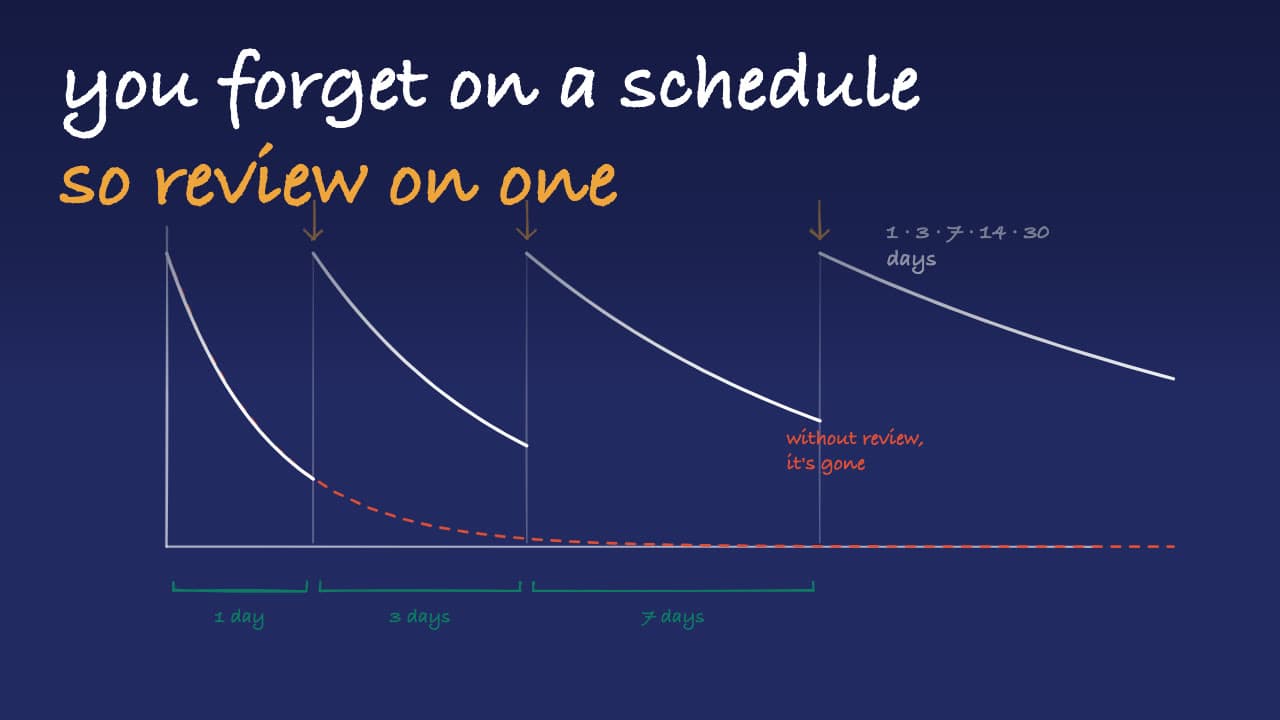
Spaced repetition is a study method that schedules reviews at increasing intervals. You revisit material just before you would forget it, which resets your memory of it and makes the next decline slower, so each review buys a longer gap than the last: a day, then three, then a week, then two, then a month. It works because memory does not fade evenly. It drops fastest right after you learn something and then flattens, and a review placed on that curve does far more than the same review placed at random.
Disclosure: Laxu AI publishes this article and is one of the tools mentioned in it. The method is explained in full before our app appears, and the free alternative is credited.
The 4-minute video version of this article. Everything below is in the video, and everything in the video is below.
Why you forget what you study
The pattern is familiar. You spend six hours on Sunday with a chapter: highlighting, rereading, feeling ready. By Friday most of it is gone, and it feels like a memory problem. It is not. It is a timing problem, and the fix takes about ten minutes a day.
The forgetting curve
In 1885 the German psychologist Hermann Ebbinghaus memorised lists of nonsense syllables and tested himself on them for weeks. He found that memory does not fade at a steady rate. It drops fastest right after you learn something, then flattens out. That shape is the forgetting curve, and everything you have ever crammed followed it.
One caution on the numbers you may have seen. The claim that you "forget 70% within a day" gets repeated everywhere, but it is not a figure Ebbinghaus reported. The finding is the shape of the curve, steep then flat, not a percentage. The first lesson is simply this: the moment you learn something is the moment you start losing it.
What a well-timed review does
If you review something right before you would have forgotten it, two things happen. Your memory of it jumps back to full. And the next decline is slower than the last one. Review it again a few days later and it is slower still. Each review buys a longer gap before the next one is needed.
That widening pattern is spaced repetition. In practice the gaps look like one day, then three, then a week, then two weeks, then a month. Not more hours of study. Better-placed ones.
The rule in one line
Review just before you forget. Remembered easily? Wait longer next time. Almost forgot it? Bring it back sooner.
Why it feels wrong, and why rereading fails
Almost nobody does this naturally, and there is a reason. Rereading feels productive, because the page looks familiar. Pulling an answer out of your head feels hard and a little unpleasant. But the hard one is the one that works. Familiarity is not memory. Roediger and Karpicke showed in 2006 that retrieving information from memory produces far better long-term retention than rereading it, and the effect has been replicated many times since.
So a review only counts if you produce the answer before you see it. If you are looking at the answer while you "review", you are rereading.
How to do it by hand
You can run spaced repetition with index cards and a calendar. The Leitner system, described by Sebastian Leitner in 1972, uses a row of boxes: a card you get right moves one box further along and is reviewed less often, a card you miss goes back to the first box and comes round again soon.
Or use Anki, which is free on Windows, macOS, Linux and Android (the iPhone app is paid) and does the scheduling for you brilliantly. Since version 23.10 it offers two schedulers, the classic SM-2 and the newer FSRS. If scheduling control is what you want, Anki is hard to beat, and our comparison of spaced repetition apps goes through the options in detail.
The catch with either route is not the reviewing. It is the setup. For a single chapter you are writing thirty or forty cards by hand before you have learned anything, and that is the point where most people quit.
How to do it with Laxu AI
This is our app, so weigh what follows accordingly. Laxu AI starts one step earlier than a flashcard app. You upload the chapter as a PDF, a photo of your handwritten notes, or the lecture recording, and it writes the cards for you. Measured across our recent uploads, a chapter produces around thirty to forty cards and is ready in under a minute.
Then you do exactly what the method needs. You see the question, answer it in your head, check, and grade yourself: Again, Hard, Good, or Easy. That grade sets when the card comes back. The scheduling idea is the same expanding-interval idea Anki uses. What is different is that you skip the part where most people give up. The same upload also gives you study notes, a practice quiz and a short study podcast, if you want them.
If you already have a deck you love in Anki, keep it. If you have a stack of PDFs and no cards yet, this is the faster way to the review stage. Try it with a PDF, a photo of your notes, or a lecture recording.
What a week actually looks like
- Ten minutes a day, on the cards that are due that day, beats three hours on Sunday. The whole method lives in the timing.
- Grade honestly. Pressing Again is not failure. It is telling the schedule where you are weak, which is exactly the information it needs.
- Do the reviews when they are due. A card reviewed a week late has usually already been forgotten, and you are relearning rather than reinforcing.
- Answer before you look. If you cannot produce the answer, that is a real result. Mark it and move on.
One question before you go
You review a card and you almost forgot it. Should the next review come sooner, or later?
Sooner. That is the whole idea. Space it out, pull it out of your head, and let the gaps grow. Our help guide covers the review screen step by step.
Sources
- Ebbinghaus, H. (1885). Über das Gedächtnis: Untersuchungen zur experimentellen Psychologie. Leipzig: Duncker & Humblot. English translation: Memory: A Contribution to Experimental Psychology (1913).
- Roediger, H. L. & Karpicke, J. D. (2006). Test-enhanced learning: Taking memory tests improves long-term retention. Psychological Science, 17(3), 249–255.
- Cepeda, N. J., Pashler, H., Vul, E., Wixted, J. T. & Rohrer, D. (2006). Distributed practice in verbal recall tasks: A review and quantitative synthesis. Psychological Bulletin, 132(3), 354–380.
- Leitner, S. (1972). So lernt man lernen. Freiburg: Herder.
- Anki: platforms, pricing and schedulers from apps.ankiweb.net and faqs.ankiweb.net, checked September 2026.
- Laxu AI card counts and timing are measured from our own production data (September 2026), not estimated.
Frequently Asked Questions
What is spaced repetition?
What is the forgetting curve?
How long should the gaps between reviews be?
Is rereading useless?
Do I need an app to do spaced repetition?
Is Anki free?
What does Laxu AI do differently from Anki?
Related articles
Continue learning with these related posts.

Put these techniques into practice
Upload your study materials and let Laxu AI create flashcards, notes, and quizzes automatically.